The Trust Deficit: Why Vendor Risk Is Now a Strategic Discipline - Not a Compliance Function

The Trust Deficit: Why Vendor Risk Is Now a Strategic Discipline — Not a Compliance Function
Third-Party Risk Management | William C Hord
This is the fourth and final article in a series that has followed one thread through the evolving state of third-party risk management at financial institutions.
The first article established that concentration risk — not individual vendor performance — is now the dominant exposure in TPRM. Most programs assess vendors one by one. The risk lives at the ecosystem level, across shared dependencies and interconnections that vendor-by-vendor assessment cannot surface. The second article established that point-in-time reviews have become structurally inadequate. A vendor's risk profile can shift from acceptable to critical faster than any annual cycle can detect, and the OCC, Federal Reserve, and FDIC have converged on a single expectation: ongoing monitoring must be continuous and commensurate with criticality. The third article named what is driving both failures: the SaaS and cloud era has introduced a category of vendor dependency that annual reviews, SOC 2 collection, and document-based assurance were never designed to manage.
Each of those articles examined a structural failure in how institutions manage vendor risk.
This final article steps back from the mechanics of program design to examine something more fundamental — and more consequential for the institutions that fail to see it clearly.
The relationship between financial institutions and their vendors is undergoing a trust recalibration that has no precedent in the modern era of TPRM. And the implications reach far beyond vendor risk programs into the strategic decisions that boards and executive leadership must now make with urgency and clarity.
What Trust Actually Means in a Third-Party Relationship
For most of the history of vendor risk management at financial institutions, trust was implicit. You selected a vendor through a due diligence process, executed a contract, collected annual documentation, and assumed that the relationship would perform as represented. Trust was the default condition, eroded only when something went visibly wrong.
That model rested on a set of conditions that no longer hold.
It rested on the assumption that vendors were transparent about their architecture, their subprocessors, their data handling practices, and their security posture — not because they disclosed those things proactively, but because the relationships were simpler and the dependencies more visible. It rested on the assumption that a vendor's risk profile was relatively stable between review cycles. And it rested on the assumption that the institution's regulatory obligations could be met by verifying what vendors told them about themselves, on a schedule that gave everyone sufficient time to prepare.
None of those assumptions remain valid in the current environment.
The Protiviti 2026 Compliance Priorities report identifies third-party risk management as a continuing top compliance priority, noting that the regulatory environment around vendor relationships is becoming simultaneously more demanding and more complex — with scrutiny of non-financial risks, including operational disruptions, reputational harm, and compliance challenges, intensifying at exactly the point when vendor ecosystems are becoming harder to see clearly.¹
The New York Department of Financial Services issued industry guidance in late 2025 explicitly signaling that it will scrutinize policies and procedures related to third-party service providers — with particular focus on covered entities that outsource cybersecurity compliance to vendors and on the risks introduced by cloud computing, AI platforms, and file transfer systems.² That is not compliance guidance about how to manage existing vendor relationships. It is a signal that regulators no longer trust that the current model of vendor oversight is producing the visibility and control that safety and soundness requires.
The trust deficit is not a perception problem. It is a structural one.
Three Dynamics That Are Eroding Vendor Trust at Financial Institutions
The current trust recalibration is being driven by three intersecting dynamics — each of which was touched in the previous articles in this series but is now converging into a single strategic pressure point.
First: Opacity has become structural, not incidental.
In the SaaS and cloud era described in the third article in this series, the information that institutions need to make informed trust decisions about their vendors is increasingly unavailable through traditional assurance mechanisms. A SOC 2 Type II report tells an institution what a vendor's controls looked like during a period that ended months before the report was reviewed. It does not disclose what subprocessors changed during that period, what new integrations were introduced, how the vendor's cloud infrastructure was restructured, or what security incidents were identified and remediated internally.
The opacity is not always intentional. SaaS vendors operate in environments that change continuously — and the assurance frameworks the industry relies on were not designed for continuous change. But the practical result is that institutions are making trust decisions based on information that does not reflect their vendor's current operational reality.
The EY Global Financial Services Regulatory Outlook 2026 characterizes the current environment as one in which risks are nonlinear, accelerated, volatile, and interconnected — demanding more rapid response and testing corporate agility in ways that static assurance cycles are structurally incapable of supporting.³ That description applies directly to the vendor assurance gap. When the risk environment is nonlinear and accelerated, annual documentation is not an assurance artifact. It is a historical record.
Second: Concentration has created systemic fragility that vendors themselves cannot fully disclose.
As the first article in this series established, the concentration risk that now defines vendor ecosystems does not exist at the individual vendor level. It exists in the shared infrastructure beneath multiple vendors simultaneously — the cloud provider running a significant portion of the institution's critical SaaS platforms, the identity management provider whose availability underpins authentication across dozens of applications, the API infrastructure through which payment integrations, compliance monitoring, and customer-facing services all flow.
A research workshop hosted by the Federal Reserve Banks of Boston, Chicago, and Dallas in February 2026 examined precisely this dynamic — the trade-offs between the efficiency gains that third-party relationships provide and the systemic vulnerabilities they introduce, with particular focus on how concentration among a small number of critical service providers creates risk that propagates across the financial system in ways that no individual institution can fully assess or control.⁴
The implication is significant: even a vendor that is fully transparent about its own architecture and security posture cannot fully disclose the risk that its own concentration within the broader ecosystem creates. The institution's aggregate exposure to a shared infrastructure failure is not visible at the vendor level. It is only visible at the ecosystem level — and most institutions do not yet have the visibility infrastructure to see it.
Third: Regulatory expectations have outpaced the assurance model.
The second article in this series documented the regulatory convergence around continuous monitoring as the expected standard for critical vendor relationships. The Interagency Guidance on Third-Party Relationships, jointly issued by the OCC, Federal Reserve, and FDIC in 2023, is unambiguous: ongoing monitoring must be commensurate with the level of risk and criticality of the relationship — not periodic by default, not triggered only by obvious performance failures, but continuous and proportionate to what is actually at stake.⁵
What has happened in the period since that guidance was issued is that the gap between what continuous monitoring requires and what most vendor assurance programs provide has become a trust gap in its own right. Institutions that are collecting annual questionnaires and periodic SOC 2 reports for critical SaaS vendors are not meeting the standard the guidance establishes. Examiners know this. And the implicit message — that institutions are representing their vendor oversight as more robust than it actually is — is itself a form of trust erosion, both in the regulatory relationship and in the institution's own understanding of its exposure.
The Institutional Response: Bringing Capabilities In-House
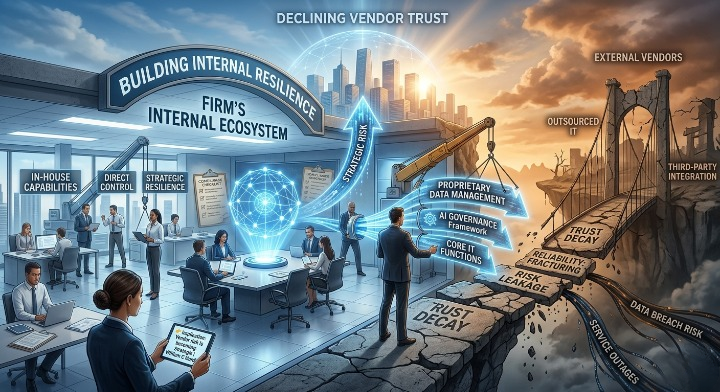
The trust deficit is beginning to produce a strategic response that would have been considered extraordinary a decade ago: a meaningful and growing number of financial institutions are bringing capabilities in-house that they previously outsourced to third parties — not primarily because in-house is more efficient or more cost-effective, but because the trust and control calculus has shifted.
The drivers are consistent across institutions making this decision.
Data sovereignty is a primary factor. As data sovereignty requirements intensify globally — and as the regulatory expectations around where data resides, who controls it, and how it moves across borders become more specific and more enforceable — the risk of outsourcing data-sensitive functions to vendors operating across complex, multinational cloud environments has grown substantially. The practical question for many institutions is no longer "can we trust this vendor?" but "can we verify the things we need to verify about this vendor's data handling, at the level of specificity that our regulatory obligations now require?" When the answer is no, insourcing becomes a genuine strategic option.⁶
Regulatory compliance complexity is a second driver. The NYDFS guidance issued in November 2025 articulates a concern that is increasingly shared across the regulatory community: when institutions outsource cybersecurity compliance functions to third parties, they remain fully accountable for the outcomes — but they lose the direct control that would allow them to verify, adapt, and defend those functions under examination.⁷ For some functions and some institutions, the compliance risk of outsourcing now exceeds the operational efficiency it provides.
The concentration exposure documented in the first article in this series is a third driver. When an institution's analysis reveals that a significant portion of its critical operational dependencies flow through a small number of shared infrastructure providers — and that a disruption to any of those providers would cascade across multiple critical services simultaneously — the risk calculus for maintaining those dependencies changes. Insourcing specific capabilities, or restructuring vendor relationships to reduce concentration, becomes a strategic risk management decision rather than an operational preference.
This is a meaningful shift. Vendor risk is no longer a program that sits alongside strategic planning. It is informing strategic planning directly — about which capabilities to maintain control over, which dependencies to reduce, and which vendor relationships require fundamental renegotiation of terms, transparency, and accountability.
From Compliance Function to Strategic Discipline
The most important implication of the trust recalibration — and the thread that connects all four articles in this series — is the reorientation of what vendor risk management is for.
For most of its institutional history, TPRM was a compliance function. Its purpose was to demonstrate, to examiners and auditors, that the institution had assessed its vendors, collected their documentation, identified the risks in those relationships, and maintained oversight on a schedule. The output was a program that could be examined and found satisfactory. The audience was primarily the regulator.
That framing is no longer adequate.
The EY and IIF Global Bank Risk Management Survey, drawing on responses from 101 banking institutions across 31 countries, finds that CROs are increasingly required to look ahead and model how risks will compound and accelerate — and that the strategic and tactical remit of risk functions is expanding in ways that require risk leadership to engage directly with board-level strategic decisions, not simply to report on compliance status.⁸
Third-party risk is at the center of that expansion. The decisions that the trust recalibration is forcing — about which capabilities to insource, which vendor relationships require fundamental restructuring, which concentrations create unacceptable systemic exposure, and which assurance mechanisms need to be rebuilt from the ground up — are not operational decisions. They are strategic ones. They affect capital allocation, technology investment, competitive positioning, and the institution's ability to serve its customers with resilience and reliability under adverse conditions.
The Deloitte 2026 Banking and Capital Markets Outlook captures this shift directly, characterizing 2026 as a year that will demand bold choices from banking leadership — choices that balance macro headwinds, technology ambition, and operational risk in ways that require strategic clarity rather than compliance incrementalism.⁹
Vendor risk is no longer a program that produces annual reports. It is a discipline that informs the institution's most consequential decisions.
What Strategic Vendor Risk Management Actually Requires
The reorientation from compliance function to strategic discipline is not primarily a technology problem or a program design problem. It is a governance and orientation problem. It requires three changes that reach beyond the vendor risk program itself.
First: Board-level visibility into concentration and trust exposure, not just vendor performance metrics.
Most board-level TPRM reporting focuses on vendor performance against SLAs, the number of critical vendors assessed in the period, and the status of high-risk findings. That reporting is appropriate for a compliance-oriented program. It is insufficient for a strategic one.
What boards need — and what the trust recalibration makes urgent — is visibility into concentration exposure across the vendor ecosystem: which critical services share infrastructure dependencies, what the aggregate impact of a specific infrastructure failure would be, and where the institution's ability to verify vendor control effectiveness has meaningful gaps. That is a different kind of reporting. It requires different data, different analysis, and a different framing of what the board is being asked to understand and decide.
Second: Vendor relationships structured around continuous transparency, not periodic assurance.
The assurance model that the TPRM industry has operated on — annual reviews, periodic SOC 2 collection, questionnaire-based self-attestation — was built for a level of trust that the current environment no longer warrants for critical vendor relationships. Rebuilding trust in those relationships requires rebuilding the assurance model.
For critical vendors, that means contractual rights to ongoing transparency: notification of material changes to architecture, subprocessors, and security posture; participation in or observation of relevant testing and recovery exercises; and access to current security information that reflects the vendor's actual posture, not a historical audit window. The interagency guidance is explicit that ongoing monitoring must be commensurate with criticality.⁵ The contract is where that expectation must be operationalized.
Third: Strategic exit and substitution planning that is genuine, not nominal.
The concentration risk documented throughout this series creates a specific strategic vulnerability: the inability to exit vendor relationships that have become critical at a level that makes substitution genuinely difficult. Exit planning that exists on paper but has never been tested against the actual operational reality of what it would take to transition away from a critical vendor — under time pressure, without the vendor's cooperation — is not exit planning. It is documentation.
The institutions that will hold up under both examination scrutiny and actual disruption are those that have treated exit planning as an operational capability — tested, validated, and maintained against current dependency conditions — rather than as a contractual formality.
The Series in Summary
Four articles. Four dimensions of the same fundamental challenge.
The first article established that vendor risk programs designed for bilateral, assessable, individual vendor relationships cannot manage ecosystem-level concentration risk. The dominant exposure in TPRM today is not any single vendor — it is the interconnected web of dependencies that makes multiple simultaneous failures possible from a single point of infrastructure failure.
The second article established that point-in-time assurance cannot support the continuous monitoring that both regulators and the current risk environment require. A vendor's risk profile moves faster than annual review cycles can detect. The grace period for static risk management has expired.
The third article established that the SaaS and cloud era has introduced a structural opacity into vendor relationships — the gap between what SOC 2 and annual questionnaires capture and what is actually happening inside the vendor's environment today — that traditional assurance mechanisms were not designed to close.
This fourth article establishes that the cumulative effect of those three dynamics is a trust deficit that is now producing strategic responses: institutions bringing capabilities in-house, restructuring vendor relationships, and reorienting TPRM from a compliance function into a discipline that informs the institution's most consequential decisions.
The Honest Assessment
The question every risk officer and every board member at a financial institution should be asking right now is not "is our vendor risk program compliant?"
The question is "do we actually trust our critical vendors — and can we verify the things we need to verify to justify that trust at the level that our regulatory obligations, our operational resilience, and our fiduciary responsibility to our customers and communities require?"
If the answer to that question relies on documentation collected annually from vendors who have significant incentive to present themselves favorably, it is not a satisfying answer. And regulators, examiners, and the disruption environment are increasingly positioned to expose the gap between the answer that documentation provides and the answer that genuine oversight requires.
Vendor risk has become a strategic discipline.
The institutions that recognize that — and build their programs, their governance, and their vendor relationships accordingly — will define best practice for the cycle ahead.
The institutions that continue to treat it as a compliance function will find that the trust deficit they have tolerated is no longer tolerable.
References
¹ Protiviti. Compliance Priorities 2026. 2026. protiviti.com
² New York Department of Financial Services / Ogletree. NYDFS Industry Letter: Third-Party Service Provider Guidance — Foreshadowing Enforcement of Vendor Management. November 2025. ogletree.com
³ EY. Global Financial Services Regulatory Outlook 2026. December 2025. ey.com
⁴ Federal Reserve Banks of Boston, Chicago, and Dallas. Workshop: Risks to the Economy and Financial System from Third Parties. February 2026. dallasfed.org
⁵ Office of the Comptroller of the Currency. OCC Bulletin 2023-17: Interagency Guidance on Third-Party Relationships: Risk Management. June 2023. occ.gov
⁶ Kiteworks. Five Critical Data Sovereignty Challenges Facing Financial Services in 2026. March 2026. kiteworks.com
⁷ New York Department of Financial Services / Ogletree. NYDFS Industry Letter: Third-Party Service Provider Guidance. November 2025. ogletree.com
⁸ EY and Institute of International Finance. Global Bank Risk Management Survey: Three Strategic Priorities for Banking CROs in 2026. February 2026. ey.com
⁹ Deloitte. 2026 Banking and Capital Markets Outlook. December 2025. deloitte.com
This is the fourth and final article in a series on the evolving state of vendor risk management at financial institutions. Previous pieces examined concentration risk as the dominant TPRM exposure, why continuous monitoring has replaced point-in-time reviews as the regulatory standard, and the SaaS blind spot in vendor assurance models.