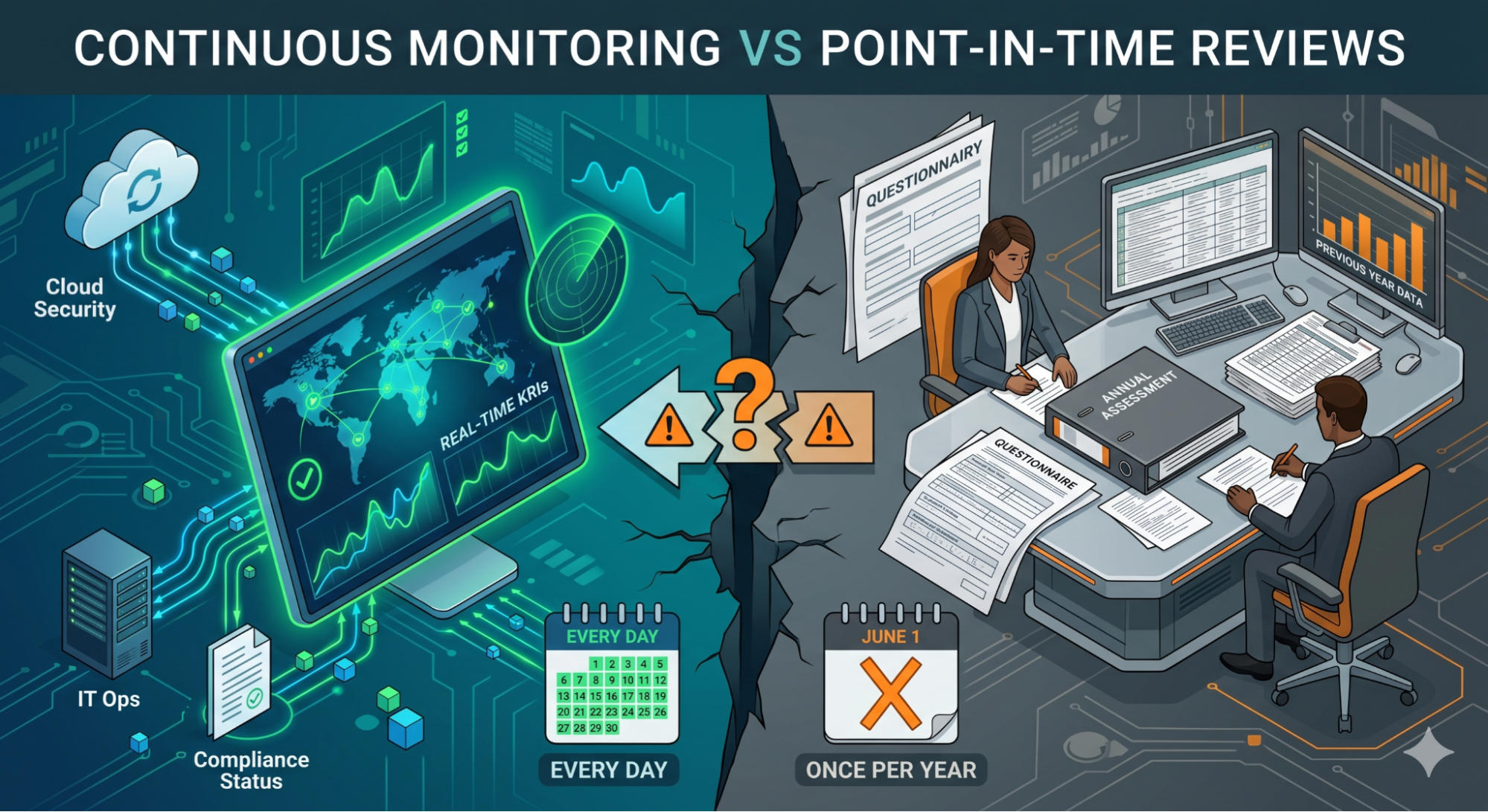
Continuous Monitoring vs Point-in-Time Reviews

Continuous Monitoring vs Point-in-Time Reviews
If you are a risk professional in 2026, you’ve likely spent the last few weeks staring at a dashboard of "Green" vendor health scores while simultaneously feeling a sense of impending dread.
The reason? We are still using a 2013 playbook to manage 2026's interconnected risks. We have become experts at the point-in-time review—the annual ritual of the 400-question SIG questionnaire—while remaining fundamentally blind to the concentration risk that now defines our ecosystem.
In the U.S. regulatory environment, the grace period for "static" risk management has expired. The OCC, Federal Reserve, and FDIC have converged on a single truth: if your vendor risk program isn't continuous, it isn't a risk program—it's a historical record.
The Mirage of the Annual Review
For years, the "Annual Review" was the gold standard. We felt secure because a vendor told us their SOC2 was clean twelve months ago. But as we’ve seen in recent systemic shocks, a vendor's risk profile can shift from "Low" to "Critical" in a single afternoon.
The Interagency Guidance on Third-Party Relationships: Risk Management (jointly issued by the OCC, Fed, and FDIC) fundamentally redefined "ongoing monitoring." It is no longer a periodic check; it is a lifecycle requirement that must be commensurate with the criticality of the activity.
"Ongoing monitoring enables a banking organization to assess whether the third party is performing as agreed and in compliance with applicable laws and regulations... The level of monitoring should be commensurate with the level of risk and criticality of the third-party relationship."
Source: OCC Bulletin 2023-17: Interagency Guidance on Third-Party Relationships
The Real Exposure: Concentration Risk
While we focus on individual vendor performance, the real systemic threat is Concentration Risk. This isn't just about having too many contracts with one provider; it's about the "Hidden Nth Party."
Regulators are now scrutinizing geographic, industry, and technological concentrations. If 40% of your critical vendors rely on the same cloud region, or the same niche AI-security API, you don't have a diversified portfolio—you have a single point of failure.
The OCC's Spring 2025/2026 Semiannual Risk Perspective highlights that "operational risk is elevated," specifically calling out the complexity of third-party environments. The risk isn't just that a vendor fails; it's that a single event triggers a cascade across your entire vendor base.
Source: OCC - Semiannual Risk Perspective, Spring 2025
The Transparency Gap: Static vs. Continuous
We are currently facing a massive Transparency Gap. According to research from FIS Global, transparency is now a top priority for roughly 38% of firms, yet our execution remains trapped in the "Questionnaire Trap."
Source: FIS Global - Risk Management Strategies for 2025/2026
A questionnaire is a self-reported, point-in-time artifact. It is the definition of "static." To meet the 2026 standard, we must move toward Continuous Monitoring fueled by real-time risk indicators (KRIs). This requires:
- Connected, Enterprise-Wide Data: As noted by MarketsandMarkets, the push for enterprise-wide data connectivity is the primary driver of ERM growth. We need to see how a vendor failure impacts our liquidity, our credit risk, and our compliance posture simultaneously.
- Automated Feeds: Replacing "How do you secure your data?" with real-time telemetry on a vendor's external security posture and financial health.
- Concentration Mapping: Visualizing your ecosystem to identify where multiple "Tier 1" vendors rely on a single "Tier 4" utility.
The Examiner's Chair: What to Expect
In your next exam, the question won't be "Did you review this vendor?" It will be "How did you know their risk changed last Tuesday?"
U.S. regulators, under Federal Reserve SR 23-4, are looking for evidence that banks can identify aggregate risk across their entire third-party inventory. They want to see that you have moved beyond the "Vendor-by-Vendor" silo and are managing the "Ecosystem."
"A banking organization’s use of third parties does not diminish its responsibility to meet these requirements to the same extent as if its activities were performed by the banking organization in-house."
Source: Federal Reserve - SR 23-4: Interagency Guidance on Third-Party Relationships
Conclusion: From Checklist to Architecture
The era of the "Check-the-Box" vendor review is dead. To defend our institutions in 2026, we must stop treating Third-Party Risk as a compliance exercise and start treating it as a resilience architecture.
We must trade our annual questionnaires for continuous monitoring. We must trade our vendor lists for ecosystem maps. And most importantly, we must recognize that the "Real Exposure" isn't what the vendor tells us—it's what they can't tell us about the web of dependencies they sit within.
ERM Pilot is built for risk and compliance teams at financial institutions who are ready to stop working for their software and start letting their software work for them. See what's possible →