The SaaS Blind Spot: Why Your Vendor Risk Program Wasn't Built for the Cloud Era

The SaaS Blind Spot: Why Your Vendor Risk Program Wasn't Built for the Cloud Era
Third-Party Risk Management | William C. Hord
There is a version of vendor risk management that made sense fifteen years ago.
You had a defined list of vendors. Each vendor provided a discrete service. You assessed them annually, collected their documentation, reviewed their SOC 2, and filed the results. Risk was bound by the contract. Oversight was periodic by design.
That model has not kept pace with how financial institutions actually operate today.
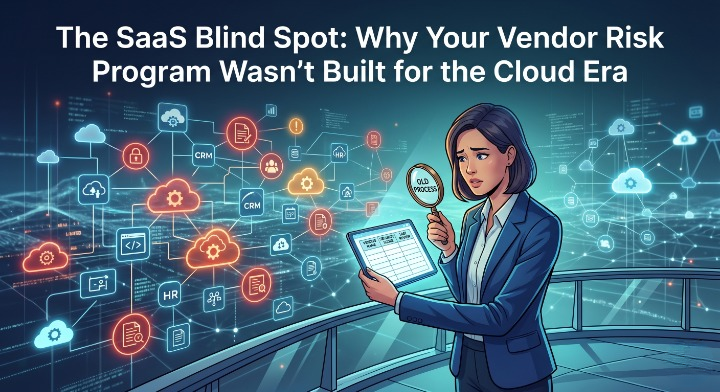
The average financial institution now relies on dozens — in many cases hundreds — of SaaS platforms embedded across its operations. Core systems. Compliance tools. Communication platforms. Payment integrations. Data analytics environments. AI-driven workflows. Each one a vendor. Each one a dependency. Each one a potential point of failure that your vendor risk program was not architecturally designed to manage in the way the risk actually behaves.
The problem is not that institutions lack vendor risk programs. The problem is that those programs were built for a vendor landscape that no longer exists — and the SaaS and cloud era has introduced a category of risk that annual reviews, point-in-time assessments, and document collection simply cannot address.
What the Previous Two Articles Established
In the first article in this series, we examined why concentration risk — not individual vendor performance — is now the dominant exposure in third-party risk management. Most programs assess vendors one by one. Concentration risk does not exist at the vendor level. It exists at the ecosystem level, across the shared dependencies and interconnections that vendor-by-vendor assessment cannot surface.
In the second article, we examined why point-in-time reviews have become structurally inadequate. A vendor's risk profile can shift from acceptable to critical faster than an annual review cycle can detect. The OCC, Federal Reserve, and FDIC have converged on a single expectation: ongoing monitoring must be continuous and commensurate with criticality — not periodic by default.
Both articles pointed at the same underlying shift without fully naming what has driven it.
The SaaS and cloud ecosystem is why concentration risk is now the dominant exposure. It is why point-in-time reviews are no longer sufficient. And it is why the next evolution of vendor risk management requires a fundamentally different approach to assurance — one built around continuous transparency rather than periodic documentation.
How SaaS Changed the Vendor Risk Equation
When financial institutions relied primarily on on-premises software and locally managed infrastructure, vendor risk was largely containable. A vendor failure affected the specific system that vendor supported. Recovery strategies could be built around that system. The blast radius was knowable.
SaaS changed that in three ways that most vendor risk programs have not fully absorbed.
First: operational dependency became invisible. On-premises software is physically present. You know what it is, where it runs, and what it connects to. SaaS lives in the cloud. It updates continuously without your involvement. It integrates with other platforms through APIs you may not fully inventory. It scales and changes on the vendor's schedule, not yours. The operational dependency is real and deep — but it is architecturally less visible than the systems it replaced.
Second: data security risk shifted off-premises. In a SaaS environment, your data does not sit on infrastructure you control. It sits on infrastructure the vendor controls, often across shared cloud environments, frequently in regions you have not explicitly approved, and always subject to the vendor's security posture rather than yours. A SOC 2 report tells you that the vendor's controls were evaluated at a point in time. It does not tell you what the vendor's security posture looks like today, or what their fourth-party cloud provider's posture looks like at any point.
Third: resilience became a shared responsibility that institutions rarely own their half of. When a SaaS vendor experiences an outage, your recovery strategy depends on that vendor's recovery capabilities — their redundancy architecture, their failover procedures, their RTO and RPO commitments. Most vendor contracts contain general language about availability and uptime. Very few contain the specific, tested, demonstrable resilience commitments that regulators now expect institutions to be able to defend. The institution carries the regulatory obligation. The vendor carries the operational control. That gap is the resilience risk.
The SOC 2 Problem
The industry has treated the SOC 2 report as the gold standard of vendor assurance for over a decade. It is a rigorous, independently audited evaluation of a vendor's security controls against a defined framework. It is genuinely valuable.
It is also, structurally, a point-in-time artifact — and in the SaaS context, that limitation matters more than most programs acknowledge.
A SOC 2 Type II report covers a period that ended months before you reviewed it. The controls evaluated were the controls that existed during that period. The vendor's environment has changed since then — new integrations, new subprocessors, updated infrastructure, modified access controls. The report does not reflect those changes. The report reflects a window that is already closed.
This is not a criticism of SOC 2. It is a description of what SOC 2 was designed to do — and what it was not designed to do.
What it was not designed to do is provide ongoing assurance about a vendor's current security posture, current subprocessor relationships, current data handling practices, or current resilience capabilities in a rapidly changing cloud environment. For that, the industry needs something different.
Analysis of the shift in financial services vendor assurance expectations is explicit: institutions are pushing for continuous transparency from SaaS providers — real-time visibility into security posture changes, subprocessor updates, and operational incidents — rather than annual documentation cycles. The expectation is moving from "show me your last audit" to "show me what changed last week."
That is a fundamentally different assurance model. Most vendor risk programs are not built for it.
The Fourth-Party Blind Spot in SaaS Ecosystems
One of the most significant and least-managed risks in the current SaaS landscape is fourth-party concentration — the shared infrastructure that sits beneath your vendors' platforms.
Most SaaS vendors run on a small number of major cloud providers. AWS, Azure, and Google Cloud collectively host a substantial majority of SaaS platforms operating today. This means that when your institution has relationships with twenty SaaS vendors across different functions, many of those vendors are running on the same underlying infrastructure.
If that infrastructure experiences a regional outage, the impact does not register as a single vendor failure in your risk program. It registers as simultaneous failures across multiple vendors — each of which is a separate line item in your vendor inventory, assessed independently, tracked independently, and managed independently.
The aggregate dependency is invisible in a vendor-by-vendor program. It is exactly the kind of concentration risk that the first article in this series identified as the dominant exposure regulators are now probing.
The question examiners are starting to ask is not only "which cloud provider do your critical vendors use?" It is "what is your total operational exposure if that cloud provider experiences a significant disruption?" Most institutions cannot answer that question because they have never aggregated their vendor inventory through the lens of shared infrastructure dependencies.
What Regulators Are Now Requiring
The Interagency Guidance on Third-Party Relationships — jointly issued by the OCC, Federal Reserve, and FDIC — establishes that ongoing monitoring must be commensurate with the level of risk and criticality of the relationship. For critical SaaS vendors, that standard cannot be satisfied by annual reviews and periodic SOC 2 collection.
What regulators are looking for in examinations is evidence of active, continuous oversight — not documentation that a review occurred on schedule.
Specifically in the SaaS context, examiners are probing:
Subprocessor transparency. Does the institution know who the vendor's critical subprocessors are? Has it assessed the risk those subprocessors introduce? Does it receive notification when subprocessors change? Most SaaS contracts include broad language permitting subprocessor changes with limited notice requirements. Most institutions do not have processes for tracking those changes or reassessing risk when they occur.
Data residency and sovereignty. Where is institutional data actually stored? In which regions? Under which jurisdictions? Is that consistent with the institution's regulatory obligations and its own policies? In a SaaS environment where vendors architect infrastructure globally, data residency is not a static fact — it can change as vendors restructure their cloud environments.
Resilience commitments that are tested, not just stated. Contracts that reference uptime guarantees and disaster recovery capabilities are not the same as validated evidence that those capabilities function as described under realistic disruption scenarios. Examiners are distinguishing between vendors that can document their resilience commitments and vendors that can demonstrate them.
Incident notification timelines. When a SaaS vendor experiences a security incident, a data breach, or a significant service disruption, how quickly does the institution find out? Most contracts establish notification timelines. Examiner scrutiny is increasingly focused on whether those timelines are enforceable and whether they have actually been met in practice.
The Assurance Gap Between What SOC 2 Provides and What SaaS Risk Requires
The honest framing is this: the assurance model built around annual questionnaires and periodic SOC 2 collection was designed for a vendor landscape where change was slow, relationships were bilateral and discrete, and risk could be meaningfully evaluated at a point in time.
In the SaaS and cloud era, change is continuous, relationships are multilayered and interconnected, and risk evolves faster than annual review cycles can track.
Closing that gap does not mean abandoning SOC 2. It means treating SOC 2 as a floor — a minimum baseline of documented control assurance — rather than a ceiling.
Above that floor, institutions that are managing SaaS risk effectively are building monitoring capabilities that provide:
Continuous visibility into vendor security posture changes — not through questionnaires but through ongoing signals: incident disclosures, subprocessor changes, material platform updates, and independent security ratings that move in real time.
Aggregated concentration mapping — a view of which vendors share underlying infrastructure, which critical services share the same vendor dependencies, and where a single failure could cascade across multiple functions simultaneously.
Contractual rights that match monitoring expectations — notification requirements, audit rights, resilience testing participation, and data return or destruction obligations that are specific, enforceable, and actively tracked rather than filed and forgotten.
Risk ratings that reflect current conditions — not ratings assigned at the last review cycle that remain static until the next one, but ratings that are updated when material changes in vendor circumstances warrant it.
The Three Questions Every Vendor Risk Program Should Be Able to Answer for Every Critical SaaS Vendor
If a vendor risk program is functioning effectively in the SaaS context, it should be able to answer three questions for every critical SaaS vendor at any point in time — not just at the last review cycle.
What has changed since the last assessment? Platform architecture updates, subprocessor changes, security incidents, personnel changes in critical security roles, contractual modifications. In a SaaS environment, the answer to this question is almost always "something." The question is whether the program has a mechanism for knowing what.
What is the current aggregate concentration exposure? Not just this vendor's risk rating in isolation, but this vendor's risk in the context of all other vendors sharing the same cloud infrastructure, serving the same critical business function, or holding the same category of institutional data. The aggregate is where the real exposure lives.
Can the institution survive an unplanned exit? Not a planned transition with six months of preparation — an unplanned exit, with the vendor unavailable on short notice. Does the institution have a realistic, tested alternative? Does it have access to its data in a portable format? Can it operate the affected business function without the vendor for a defined period? The answer to this question is more honest about resilience than any uptime guarantee in any contract.
The Honest Assessment
The SaaS era has fundamentally changed what vendor risk management requires. The programs that were built for annual reviews, bilateral relationships, and on-premises infrastructure are not structurally equipped to manage the concentration risk, the continuous change, and the shared infrastructure dependencies that define the current environment.
That is not a failure of the people who built those programs. It is a description of how quickly the vendor landscape evolved and how much the assurance model needs to catch up.
The institutions that will hold up under examination scrutiny — and more importantly, the institutions that will actually be resilient when something fails — are the ones that treat SaaS vendor risk as a continuous monitoring problem, not a periodic documentation exercise.
The SOC 2 is not enough. The annual review is not enough. The contract language is not enough.
What is enough is a program built around continuous transparency, aggregate concentration visibility, and assurance that reflects how vendors actually operate today — not how they represented themselves last year.
This is the third article in an ongoing series on the evolving state of vendor risk management at financial institutions. Previous pieces examined concentration risk as the dominant TPRM exposure and why continuous monitoring has replaced point-in-time reviews as the regulatory standard.