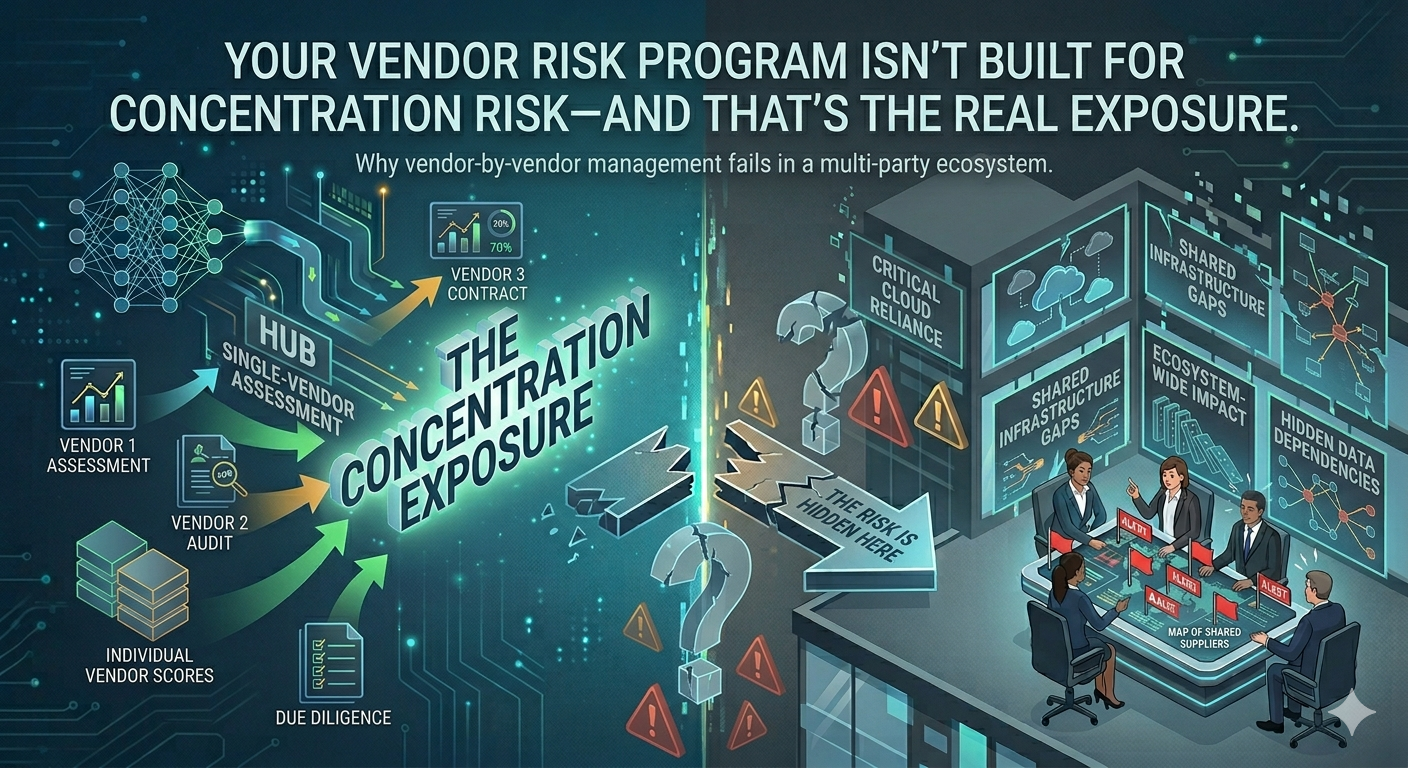
Your Vendor Risk Program Isn’t Built for Concentration Risk—And That’s the Real Exposure

Your Vendor Risk Program Isn’t Built for Concentration Risk—And That’s the Real Exposure
For years, third-party risk management has been structured around a simple idea:
- Identify vendors
- Assess risk
- Perform due diligence
- Review annually
That model worked when vendor ecosystems were smaller and more distributed. It doesn’t hold up anymore.
The Shift: Vendors Are Now Systemically Important
Financial institutions today rely heavily on cloud providers, core processors, SaaS platforms, and fintech integrations.
Regulators have taken notice. Global guidance from the Financial Stability Board highlights growing concern around concentration risk in critical third-party service providers and the systemic impact of their failure.
Similarly, U.S. regulators have emphasized the need for stronger oversight of critical service providers and interconnections across the financial system.
The Big Change
We’ve moved from “Is this vendor risky?” to “What happens if this vendor fails—and how many critical services go with it?”
That’s a fundamentally different risk question.
Why Traditional TPRM Falls Short
Most programs are still vendor-by-vendor, assessment-driven, and point-in-time.
But concentration risk doesn’t show up that way.
It shows up when:
- Multiple critical services rely on the same vendor
- Multiple vendors rely on the same subservice provider
- A single outage creates cascading impact
And most institutions don’t have visibility into that level of dependency.
Supply Chain Risk Is No Longer Theoretical
Regulators and cybersecurity agencies have been clear: supply chain attacks are increasing in both frequency and impact.
The Cybersecurity and Infrastructure Security Agency has repeatedly warned that compromising a single trusted vendor can provide access to multiple downstream organizations (https://www.cisa.gov/supply-chain).
That’s the nature of modern vendor ecosystems: highly interconnected, highly leveraged, and highly exposed.
What Examiners Are Now Focused On
We’re seeing a clear shift in examination focus:
1. Critical Vendor Identification
Not all vendors are equal. Examiners want to know which vendors are critical, how they are defined, and what services depend on them.
2. Concentration Risk
This is where most programs break down.
Questions now include:
- How many critical services rely on the same provider?
- Where are single points of failure?
- What is your exposure to cloud concentration?
3. Exit & Substitution Planning
This is no longer theoretical. Regulators expect realistic exit strategies, alternative providers, and tested transition plans—not just documentation, but feasibility.
Where It Breaks in Practice
The issue isn't a lack of policy. It’s a lack of connected visibility.
In most environments, vendor data lives in one system, risk data in another, and business services somewhere else.
There’s no clear way to answer: “If this vendor fails, what actually happens across the organization?”
This Is Not a Vendor Risk Problem—It’s a System Design Problem
Legacy TPRM tools were built for due diligence workflows, document collection, and periodic reviews.
They weren’t built for dependency mapping, concentration analysis, and real-time impact assessment.
That gap becomes critical as vendor ecosystems scale.
What a Modern Approach Requires
To manage where risk actually exists today:
1. Service-to-Vendor Mapping
Not just vendor lists, but which vendors support which critical services.
2. Concentration Visibility
Clear insight into shared dependencies, single points of failure, and systemic exposure.
3. Real-Time Impact Awareness
When a vendor issue occurs: what services are affected, what risks are triggered, and what actions are required?
4. Executable Exit Strategies
Not static plans, but actionable workflows, defined ownership, and validated alternatives.
Where This Is Going
Third-party risk is no longer a compliance exercise or documentation function.
It’s becoming a core operational risk discipline tied directly to resilience and continuity.
And it requires systems that can connect vendors to services, trace dependencies, and surface concentration risk in real time.
Bottom Line
Most institutions don’t have a vendor risk problem. They have a visibility problem.
They can assess individual vendors, but they can’t fully see how those vendors connect, where risk concentrates, and what happens when one fails.
That’s exactly where regulators are looking next.
ERM Pilot is built for risk and compliance teams at financial institutions who are ready to stop working for their software and start letting their software work for them. See what's possible →