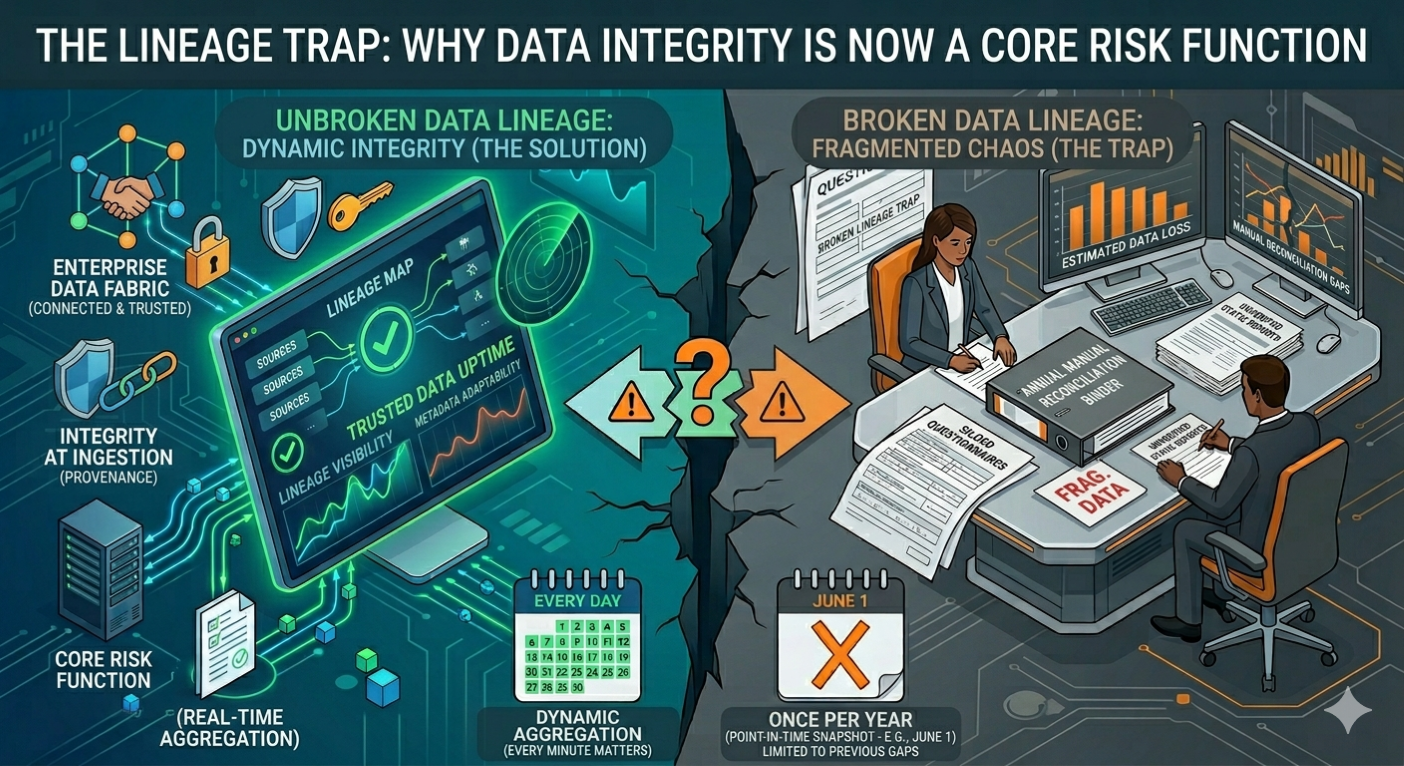
The Lineage Trap: Why Data Integrity is Now a Core Risk Function

The Lineage Trap: Why Data Integrity is Now a Core Risk Function
In the risk management landscape of 2026, we have reached a critical inflection point. For the past decade, we viewed risk data aggregation as a "T+1" compliance chore—a secondary process designed to satisfy the ghost of BCBS 239. But as we navigate a world of instant liquidity shifts and algorithmic market volatility, the U.S. regulatory body has changed the locks.
The message from the OCC, Federal Reserve, and FDIC is clear: Risk data is no longer a byproduct of your operations; it is the operation. If you cannot defend the integrity and lineage of your aggregated risk data in real-time, you do not have a risk management program—you have a reporting function.
The Real-Time Mandate: A Market Driven by Necessity
We are currently seeing a massive shift toward real-time risk visibility and connected, enterprise-wide data. This isn't just an internal preference; it is a market-mandated survival trait. According to current projections, the global Enterprise Risk Management (ERM) market is expanding at a Compound Annual Growth Rate (CAGR) of 14.8% through 2030, specifically driven by the demand for real-time visibility into enterprise-wide risks and automated compliance.
Source: MarketsandMarkets - Enterprise Risk Management Market Report 2025-2030
While the investment is there, the execution is lagging. We are witnessing the "Transparency Paradox." Research from FIS Global highlights that transparency is now a top priority for approximately 38% of firms. Yet, the same institutions are finding that "transparency" is impossible to achieve when the underlying data architecture is a patchwork of legacy silos.
The Regulatory Lens: Beyond "Accurate" to "Traceable"
In the United States, the bar for "satisfactory" risk governance has been raised by the OCC’s Heightened Standards (12 CFR Part 30, Appendix D). Specifically, Section II.J mandates that a covered bank must maintain a data architecture that supports risk aggregation and reporting during both normal and stressed periods.
The OCC’s Fall 2025 Semiannual Risk Perspective (published December 2025) explicitly warns that operational risk remains elevated across the federal banking system. The primary culprit? Legacy technology infrastructure. These systems reveal operational vulnerabilities when tasked with complex data aggregation, leading to a "reconciliation burden" that prevents real-time responses.
Source: OCC - Semiannual Risk Perspective, Fall 2025
When an examiner asks to see the "lineage" of a credit concentration metric, they aren't looking for a spreadsheet. They are looking for an automated trail that proves the data hasn't been "massaged" at four different waypoints between the source and the report.
The Practical Failure: Fragmented Systems and Inconsistent Reporting
What’s happening in practice at many of our institutions? We have "Gold Standard" policies and "Bronze Standard" infrastructure.
- The Reconciliation Trap: Many firms still rely on manual "top-side adjustments" to bridge the gap between Front Office data and Risk data. If a human has to touch the data to make it "fit" the aggregation model, the integrity is compromised.
- Fragmented Taxonomies: When your Commercial Lending system classifies an industry as "Energy" and your Market Risk system classifies it as "Utilities," the aggregated view is mathematically flawed.
- The Lineage Gap: The Federal Reserve’s SR 14-3 guidance remains the definitive benchmark for risk data aggregation. It emphasizes that data must be "adaptable" and "reconcilable." In 2026, if your reconciliation process takes longer than an hour, it is considered a failure of adaptability.
Source: Federal Reserve - SR 14-3: Guidance on Monitoring Risk Data Aggregation
The Path Forward: From Reporting to Architecture
To defend the risk function, we must stop acting like auditors and start acting like architects. The shift requires three fundamental changes in strategy:
- Metadata Sovereignty: Every piece of data entering the risk engine must carry its "biography" with it—source, timestamp, owner, and transformation logic. Without metadata, you have numbers without context.
- Unified Data Fabrics: We must move away from the "Extraction-Transformation-Loading" (ETL) mindset and toward a "Data Fabric" or "Data Mesh" approach where risk data is accessible in its native environment but governed by a centralized taxonomy.
- The "30-Minute Rule": If your risk team cannot produce a full lineage audit trail for any material risk metric in under 30 minutes, your reporting is functionally opaque.
The FDIC’s 2025 Risk Review underscores that market and credit risks are increasingly interconnected. You cannot manage a credit exposure if you don't understand the market liquidity risk of the collateral—and you can't understand that relationship without enterprise-wide data connectivity.
Source: FDIC - 2025 Risk Review
Conclusion
As risk professionals, we must accept that data integrity is our most valuable asset. The "Risk Aggregation" problem isn't just an IT headache; it is the core exposure of the modern financial institution. In a world of real-time expectations, our ability to defend our data is the only thing standing between resilience and a regulatory MRA (Matter Requiring Attention).
It’s time to move the "Risk Data" conversation from the server room to the Boardroom.
ERM Pilot is built for risk and compliance teams at financial institutions who are ready to stop working for their software and start letting their software work for them. See what's possible →