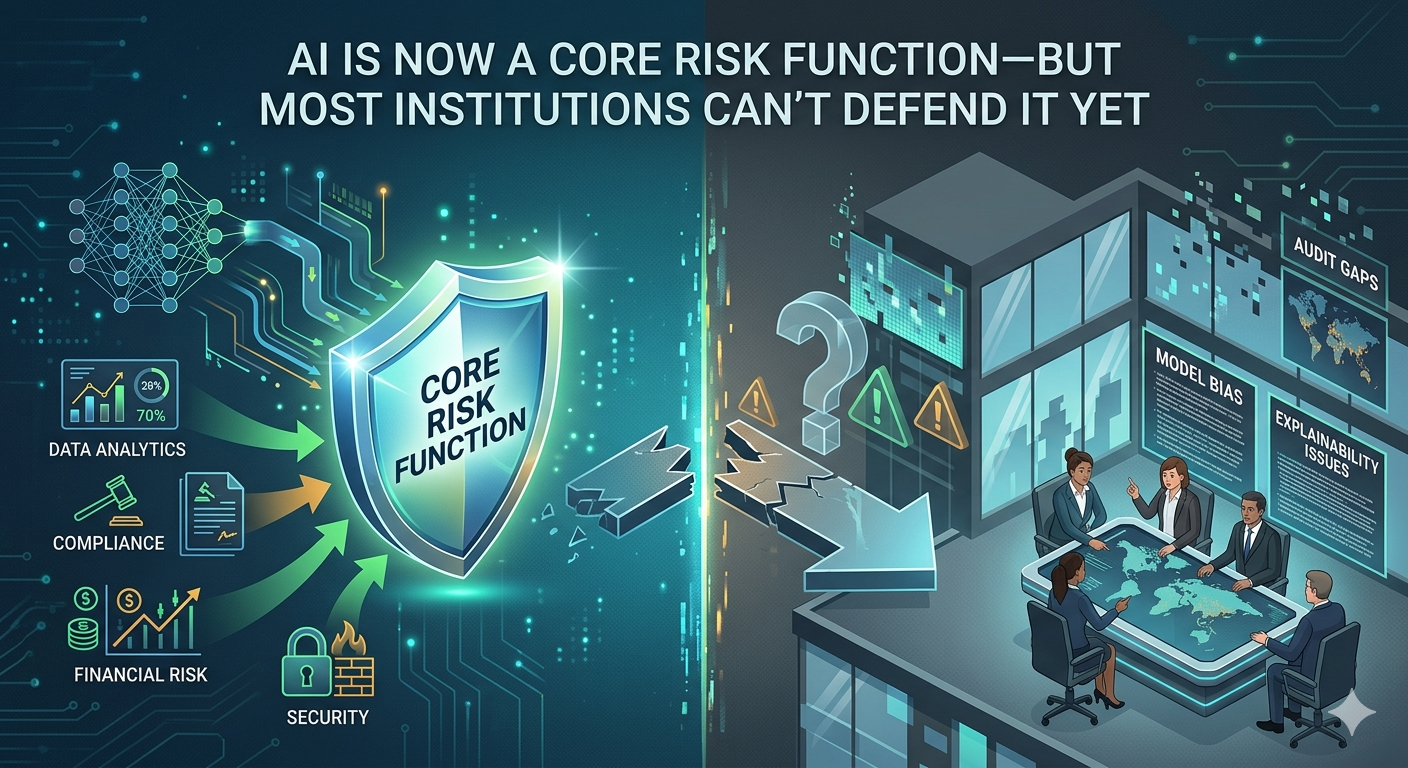
AI Is Now a Core Risk Function—But Most Institutions Can’t Defend It Yet

AI Is Now a Core Risk Function—But Most Institutions Can’t Defend It Yet
There’s no longer any debate—AI is already embedded across financial institutions.
It’s showing up in:
- Risk Identification
- Control Design
- Issue Management
- Reporting Workflows
And adoption is accelerating. Financial institutions are actively expanding AI use cases across operations and risk functions (deloitte.com)
At the same time, regulators are beginning to test how AI impacts the financial system—not just individual models (reuters.com)
The Gap Isn’t AI Adoption—It’s Risk Control
Most institutions aren’t struggling to use AI. They’re struggling to control what it’s doing.
From a risk perspective, AI introduces a different class of exposure:
- Outputs aren’t always repeatable
- Logic isn’t always transparent
- Decisions can’t always be explained
Regulators have already highlighted that AI-specific risks are harder to monitor than traditional models (fsb.org)
And Governance Is Lagging—By a Lot
Despite rapid adoption:
- Fewer than 25% of organizations have formal AI governance frameworks in place (knostic.ai)
That’s the real issue.
Because once AI is embedded in workflows, the risk isn’t theoretical anymore—it’s operational.
What Examiners Are Starting to Ask
The shift is subtle—but important.
It’s no longer:
“Are you using AI?”
It’s:
- How are AI-generated outputs governed?
- What controls exist before decisions are finalized?
- Can you trace how a risk, control, or issue was created?
- Who is accountable for the outcome?
This is where most environments start to break down.
Where Things Actually Fail (In Practice)
It’s not usually the AI model itself.
It’s what happens around it:
- AI generates a risk → no standardized review
- AI suggests a control → inconsistent approval
- AI creates an issue → no traceable linkage to source
Now multiply that across:
- Multiple Teams
- Multiple Systems
- Multiple Interpretations
You end up with:
- Inconsistent Decisions
- Conflicting Records
- And No Clear Audit Trail
This Is Not Just an AI Problem—It’s a System Design Problem
Most legacy GRC / ERM platforms weren’t built for:
- AI-Generated Inputs
- Dynamic Decision-Making
- Real-Time Traceability
They assume:
- Structured Data
- Manual Workflows
- Static Relationships
That model breaks quickly when AI is introduced.
What a Modern Approach Needs to Do
If AI is going to sit inside risk workflows, the platform itself has to change.
At a minimum:
1. Built-In Decision Governance
Not just capturing data—but:
- Enforcing review steps
- Standardizing approvals
- Documenting rationale
2. Full Traceability (Not Just Data Lineage)
You need to answer:
- Where did this come from?
- What influenced it?
- What changed along the way?
Across:
- Risks
- Controls
- Issues
- AI-generated content
3. AI That Operates Inside Guardrails
AI should:
- Accelerate workflows
- Not bypass governance
That means:
- Scoped access
- Auditable usage
- Required human validation
Why This Matters Right Now
AI is scaling faster than risk frameworks.
That’s not new.
What is new is how quickly exam expectations are shifting.
The institutions that will struggle aren’t the ones using AI.
They’re the ones that:
- Can’t explain outputs
- Can’t reconcile decisions
- Can’t trace results back to source
Where This Is Going
Risk platforms are moving toward AI-native environments where governance, traceability, and decision consistency are built in—not layered on after the fact.
That’s the difference between using AI and controlling AI in a defensible way.
Bottom Line
AI is already in your risk program—whether formally or informally.
The real question is: can you explain, govern, and defend what it’s doing?
Because that’s exactly where scrutiny is heading next.
ERM Pilot is built for risk and compliance teams at financial institutions who are ready to stop working for their software and start letting their software work for them. See what's possible →
Related Reading
- Your BCM Plan Isn’t the Problem—Your Ability to Execute It Is
- Your Vendor Risk Program Isn’t Built for Concentration Risk—And That’s the Real Exposure
- The Lineage Trap: Why Data Integrity is Now a Core Risk Function
- From Reactive to Predictive: How AI Changes the ERM Workflow for Financial Institutions