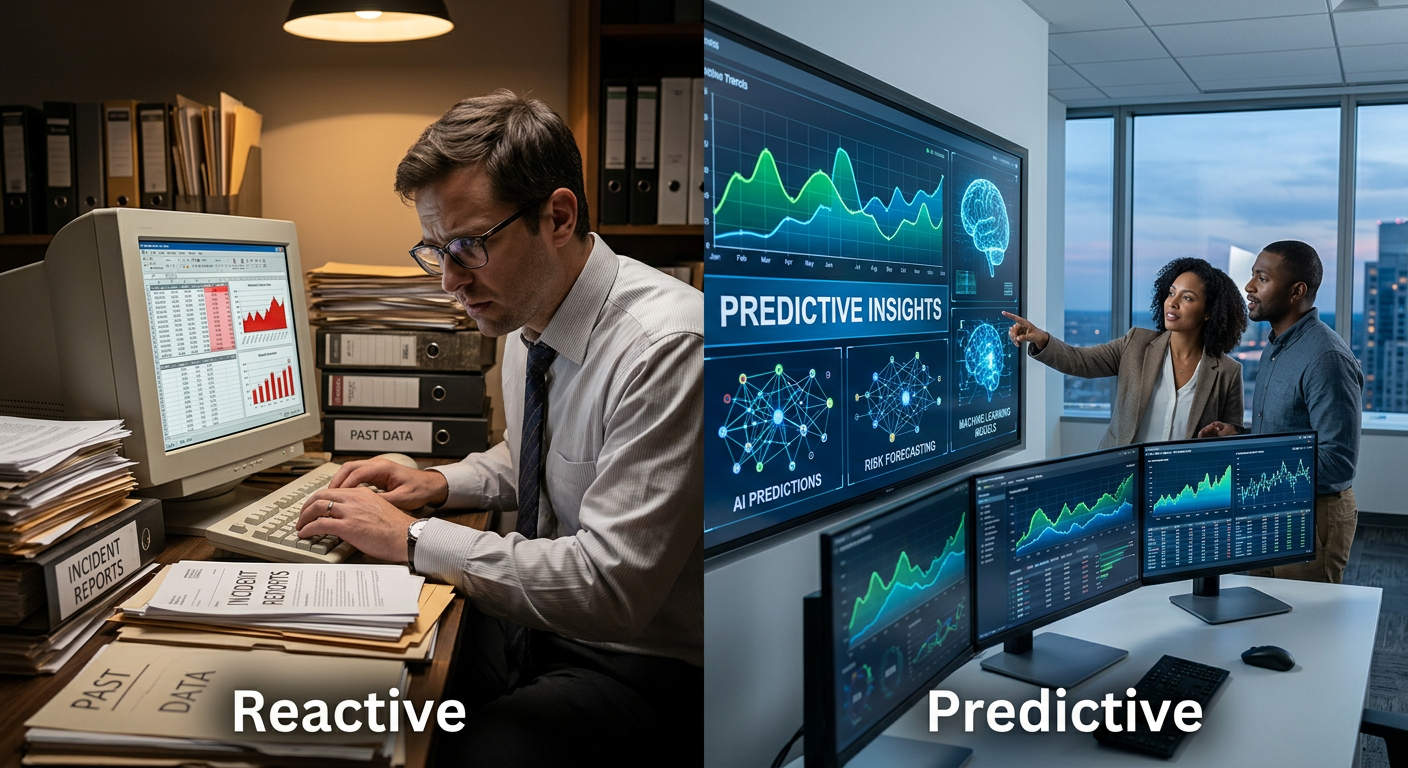
From Reactive to Predictive: How AI Changes the ERM Workflow for Financial Institutions

For decades, Enterprise Risk Management in financial institutions has followed a familiar rhythm.
Assess. Review. Report. Escalate.
Even in highly mature organizations, most ERM workflows are still designed to explain what already happened. Risk is captured through periodic assessments, interviews, surveys, and control testing cycles. Data is consolidated, validated, and presented to leadership weeks—or months—after underlying conditions began to change.
AI introduces a fundamentally different operating model.
Not faster reporting.
Not better dashboards.
A different workflow. The real shift is from reactive risk documentation to predictive risk intelligence.
From Assessment-Driven Workflows To Signal-Driven Workflows
Traditional ERM workflows are built around structured, human-driven inputs. Risk events are logged after the fact. Control failures are documented once an issue has been identified. Emerging risks rely heavily on expert judgment and periodic horizon scanning exercises.
This approach works for governance and compliance. It struggles with speed, scale, and complexity.
Modern financial institutions generate enormous volumes of operational signals every day—transaction anomalies, system performance data, access behavior, vendor activity, customer complaints, incident logs, and regulatory updates. Most of this data never enters the ERM workflow at all.
AI changes this by shifting the starting point of risk management.
Instead of beginning with a risk register, the workflow begins with live operational signals.
Models can continuously ingest data streams across technology, operations, third parties, and customer activity. Patterns, anomalies, and behavioral shifts become inputs to risk analysis long before a formal issue is raised or a control is tested.
The result is an ERM workflow that detects risk conditions as they form—not after they mature.
From Periodic Risk Reviews To Continuous Risk Sensing
In a reactive workflow, risk teams ask the business:
"What risks have changed since the last assessment?"
In a predictive workflow, the system asks a different question:
"What signals suggest risk is changing right now?"
AI enables continuous monitoring across domains that were previously analyzed in isolation. A deterioration in vendor performance, a spike in access exceptions, a rise in processing errors, and an increase in customer complaints can be correlated automatically—long before any single team escalates an issue.
The workflow becomes signal-driven rather than assessment-driven.
Risk professionals move from collecting information to validating and interpreting machine-identified patterns. This is not automation of judgment. It is an amplification of awareness.
From Static Risk Relationships To Learned Risk Pathways
One of the most significant changes occurs in how institutions understand risk relationships.
Traditional ERM workflows treat risks, controls, issues, and events as separate records linked manually through workflows and mappings. These links are usually static and heavily dependent on user input. AI changes this by learning relationships directly from data.
Controls that consistently precede certain types of incidents can be identified automatically. Operational failures that repeatedly lead to regulatory findings can be detected as recurring pathways. Third-party issues that correlate with customer or financial impacts can be surfaced without relying on manual tagging.
Instead of asking teams to define all relationships upfront, the system continuously learns how risk actually propagates through the organization. This fundamentally changes scenario analysis.
Scenarios no longer depend solely on workshops and expert assumptions. They can be informed by historical and real-time behavioral patterns observed across systems and operations.
From Horizon Scanning To Data-Driven Emerging Risk Detection
The workflow shift also fundamentally changes how emerging risk is handled.
In most institutions today, emerging risk programs rely on expert panels, market monitoring, and structured horizon scanning. These processes are valuable—but inherently limited by human bandwidth and subjective interpretation. AI augments this by scanning far broader information environments at scale.
External news, regulatory communications, industry incidents, internal event trends, and operational telemetry can be analyzed together. Weak signals that would never rise to the level of a formal issue can be identified as early indicators. The emerging risk workflow becomes continuous rather than periodic.
Instead of producing quarterly narratives, risk teams are alerted when conditions statistically resemble early stages of past disruptions or failures—inside or outside the organization.
From Manual Risk Operations To Machine-Supported Execution
Perhaps the most practical change appears in day-to-day risk operations.
Today, a significant portion of risk teams' time is spent preparing data for use:
- cleaning it,
- reconciling it,
- classifying it, and
- aligning it across systems.
AI can automate large portions of this work.
Document ingestion, issue classification, control mapping, taxonomy alignment, and event categorization can be handled at machine scale. This reduces the friction that slows down nearly every risk process—from issue triage to executive reporting.
More importantly, it allows human effort to shift toward analysis and decision support rather than data preparation. The ERM workflow becomes analytical instead of administrative.
From Advisory Risk Functions To Decision-Embedded Risk Intelligence
However, the most important transformation is not operational. It is strategic.
Predictive ERM changes the role of the risk function inside the institution.
When risk insights arrive after business decisions are made, ERM remains advisory. When risk signals appear while conditions are forming, ERM becomes embedded in decision-making.
AI enables risk teams to provide forward-looking insights such as:
- which processes are statistically trending toward failure
- which third parties are showing early warning signs of disruption
- which controls are losing effectiveness as operating conditions change
- which combinations of events are likely to amplify impact
This allows leadership to intervene earlier—often before issues become visible to customers, regulators, or the market.
What AI Does Not Replace In ERM
It is equally important to be clear about what AI does not replace.
- It does not eliminate the need for governance.
- It does not remove accountability.
- It does not replace expert judgment.
Instead, it reshapes where judgment is applied.
Human expertise moves upstream—from validating reports to interpreting predictions, assessing implications, and guiding action.
The Data And Architecture Reality Behind Predictive ERM
There is also a hard truth many institutions are beginning to confront.
AI cannot transform ERM workflows if the underlying environment remains fragmented.
Predictive workflows depend on connected data models, consistent taxonomies, shared definitions of risks and controls, and traceable relationships between events, issues, and outcomes.
Without this foundation, AI will be limited to narrow use cases such as summarization and classification.
The shift from reactive to predictive is not primarily a technology upgrade.
It is an operating model change.
The Future ERM Workflow
The future ERM workflow in financial institutions will not be built around assessment calendars and reporting cycles. It will be built around continuous signal ingestion, real-time risk pattern detection, and forward-looking insight delivery.
The institutions that succeed will be those that stop asking how AI can make their existing ERM processes faster—and start asking how ERM itself must change when risk can finally be seen before it materializes.
ERM Pilot is built for risk and compliance teams at financial institutions who are ready to stop working for their software and start letting their software work for them. See what's possible →