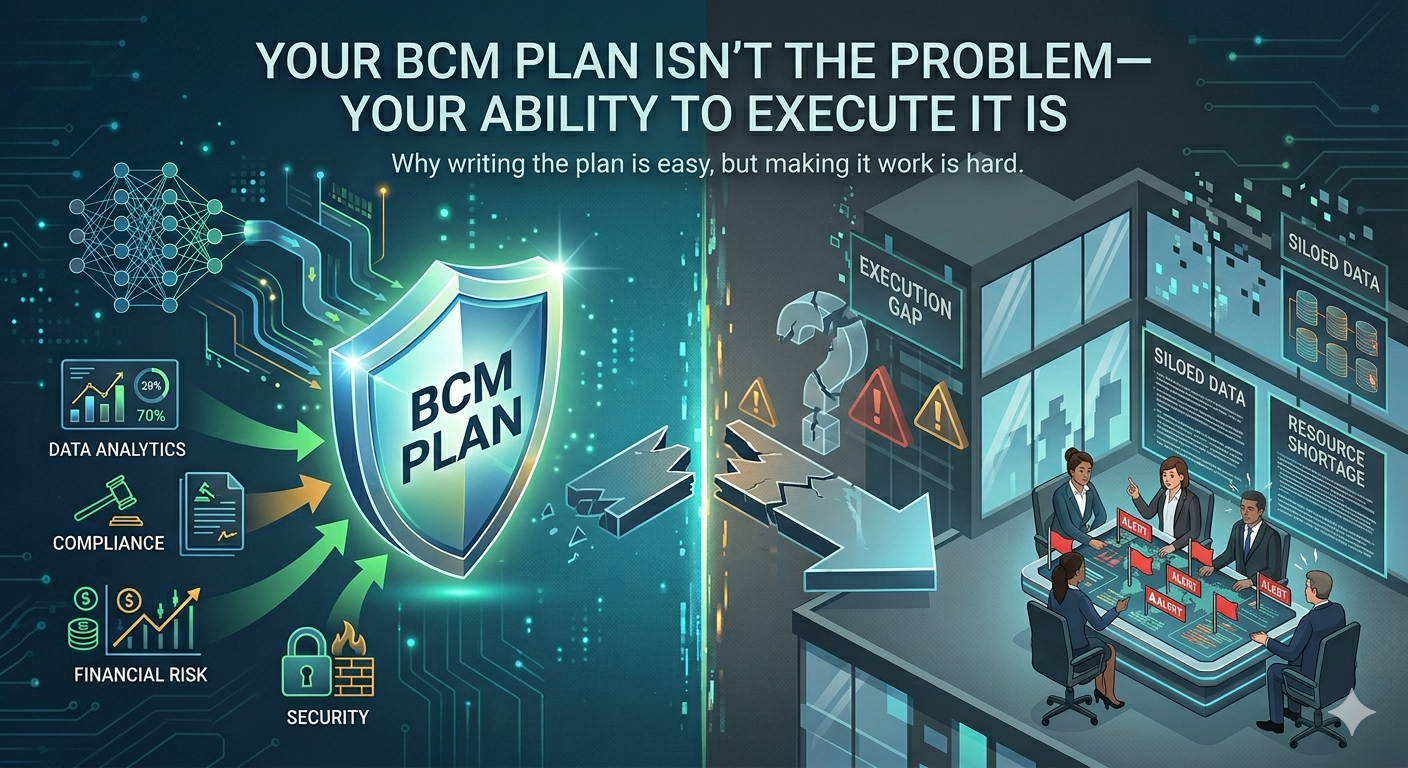
Your BCM Plan Isn’t the Problem—Your Ability to Execute It Is

Your BCM Plan Isn’t the Problem—Your Ability to Execute It Is
For years, Business Continuity Management was largely plan-driven.
- Document the scenario
- Define recovery steps
- Test annually
And for a long time, that was enough.
It isn’t anymore.
Regulators Have Moved—Quietly but Significantly
Across financial services, there’s been a clear shift toward operational resilience.
Regulatory frameworks in the U.S. and the EU are explicit: institutions must demonstrate the ability to continue critical operations under disruption, not just document recovery plans.
Regulators are emphasizing:
- Impact tolerance
- Service continuity
- Severe but plausible scenario testing
The Big Shift
We’ve moved from “Do you have a plan?” to “Can you actually operate through disruption?”
That’s a very different question, and most BCM programs weren’t built to answer it.
Where Traditional BCM Breaks Down
In practice, failures don’t come from missing plans.
They come from execution gaps:
- Critical services aren’t clearly defined
- Dependencies (systems, vendors, people) aren’t fully mapped
- Recovery strategies don’t reflect real-world constraints
- Testing doesn’t simulate actual disruption
When something breaks, organizations discover: the plan exists—but the organization can’t execute it as designed.
The Reality: Resilience Is a System Problem
Operational resilience isn’t just BCM. It sits across technology, third-party risk, operations, and enterprise risk.
And most institutions manage those areas in separate systems.
That creates a major issue:
- BCM defines recovery steps
- Vendor risk tracks third parties
- ERM tracks risks
But nothing connects them in real time.
What Regulators Are Starting to Look For
The shift in exams is becoming clearer:
- What are your critical business services?
- What dependencies support them?
- What happens when one of those dependencies fails?
- Can you continue operating within defined tolerance levels?
And most importantly: can you prove it, not just describe it?
Why This Is Getting Harder
Two things have changed:
1. Interconnected Dependencies
Organizations now rely heavily on cloud platforms, SaaS providers, and third-party integrations. Disruption rarely happens in isolation anymore.
2. Speed of Failure
Events unfold faster across cyber incidents, vendor outages, and system failures.
There’s less time to interpret, escalate, and respond manually.
What a Modern Resilience Approach Requires
To meet where expectations are going, BCM has to evolve beyond documentation.
At a minimum:
1. Service-Centric Modeling
Not just applications and departments, but end-to-end business services.
2. Dependency Mapping
Clear visibility into systems, vendors, internal processes, and how they connect.
3. Real-Time Traceability
When something fails: what is impacted, what is downstream, and what actions are triggered?
4. Executable Workflows
Plans need to translate into actionable steps, assigned ownership, and trackable execution—not static documents.
Where Most Platforms Fall Short
Traditional BCM tools were built for documentation, compliance, and periodic testing.
They weren’t built for real-time execution, cross-functional visibility, and dynamic disruption scenarios.
That gap becomes very visible during an actual event.
What This Means Going Forward
Operational resilience is becoming a live, continuously managed capability—not a periodic exercise.
And that requires systems that can connect risks, vendors, and services, trace impact in real time, and support decision-making under pressure.
Bottom Line
Most institutions don’t lack BCM plans. They lack the ability to execute them under stress, adapt them in real time, and prove they work across interconnected systems.
That’s where scrutiny is going. And that’s where programs will either hold up—or break.
ERM Pilot is built for risk and compliance teams at financial institutions who are ready to stop working for their software and start letting their software work for them. See what's possible →