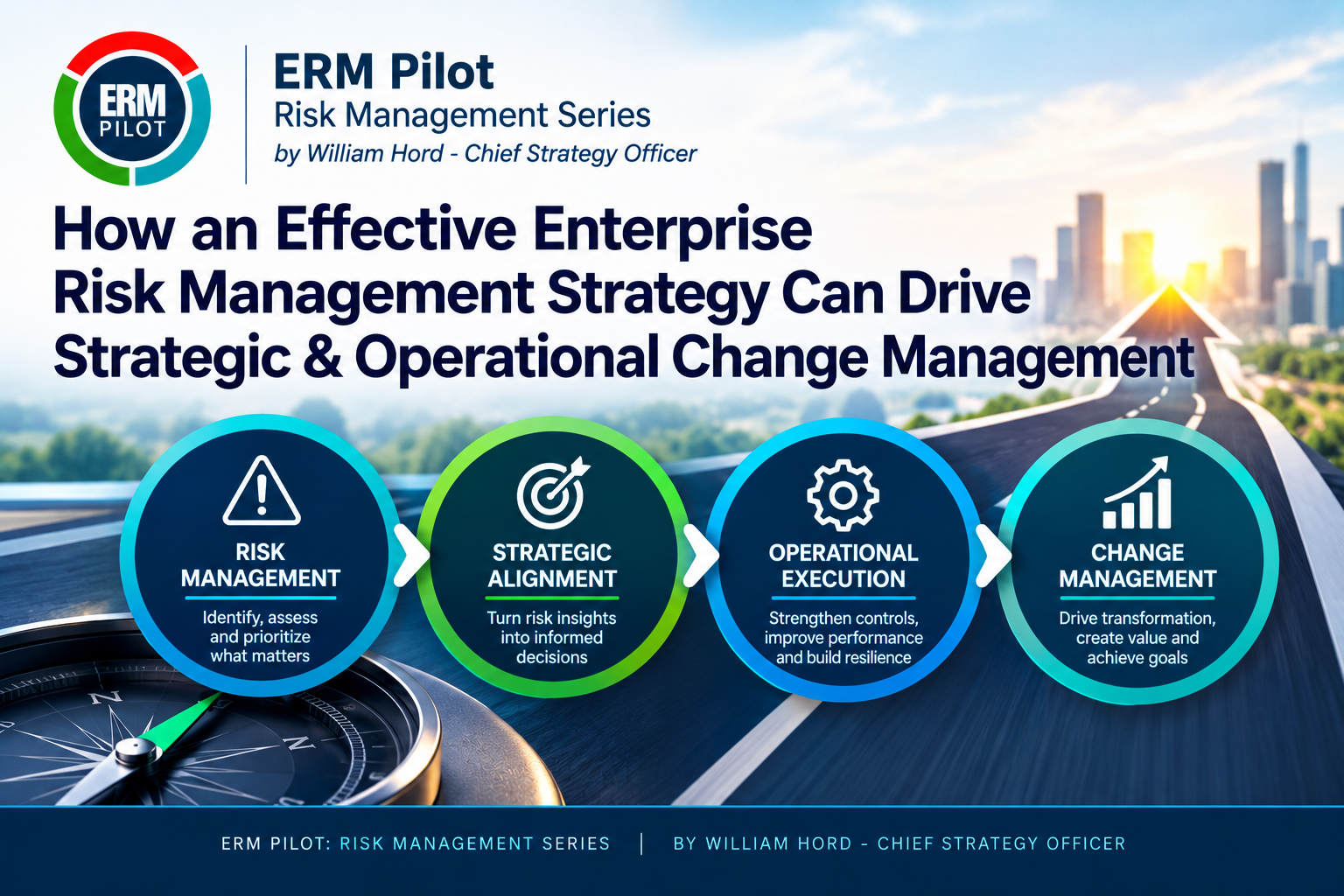
How an Effective Enterprise Risk Management Strategy Can Drive Strategic & Operational Change Management

How an Effective Enterprise Risk Management Strategy Can Drive Strategic & Operational Change Management
ERM Pilot | Enterprise Risk Management Series by William Hord, Chief Strategy Officer
Executive Summary
Financial institutions operate in an environment of relentless change-new products, mergers, digital transformation, and evolving regulatory requirements. When change is treated as a risk-driven initiative, organizations move from reactive firefighting to proactive value creation.
This paper demonstrates how an Enterprise Risk Management (ERM) framework can be the backbone of a robust change-management program. By aligning every change request with the institution's risk appetite, mapping strategic objectives to operational processes, and embedding the Three-Lines Model of assurance, senior leaders gain a repeatable, data-driven approach to transformation.
The methodology is built on three pillars:
- Strategic (top-down) and operational (bottom-up) data mapping - a clear visual language that links high-level goals to the underlying processes, products, and controls.
- Impact-tangent analysis - systematic identification of downstream effects whenever a strategic objective, business process, or product/service changes.
- A five-step change-management cycle (Identify -> Analyze -> Approve/Deny -> Create & Implement -> Monitor & Report) that integrates risk data at every stage.
When applied consistently, this framework reduces implementation risk, improves governance, and provides the board with transparent, risk-adjusted decision metrics.
"If you want to make enemies, try to change something." — Woodrow Wilson Interpretation: Change inevitably creates friction. A well-designed ERM-linked change program anticipates that friction and turns it into an opportunity for risk-aware improvement. |
1. Why Change Management Matters for Financial Institutions
Financial institutions experience change continuously across all levels of the organization. Change can arise from:
- Regulatory shifts - new compliance mandates, capital-requirement updates.
- Digital transformation - cloud migration, AI-driven analytics, mobile-first channels.
- Product innovation - new loan products, fintech partnerships, omnichannel services.
- Mergers & acquisitions - integration of systems, cultures, and risk profiles.
Each of these drivers introduces new or amplified risks (credit, operational, reputational, cyber, vendor, etc.). Without a disciplined approach, institutions react after problems surface, incurring costly remediation, reputational damage, and regulatory penalties.
A risk-integrated change-management program enables institutions to anticipate, quantify, and mitigate those risks before they materialize.
2. Enterprise Risk Management as a Change-Enablement Framework
ERM provides a single source of truth for both strategic direction and operational execution. It does so by:
- Embedding risk appetite into strategic planning (COSO 2017, ISO 31000 2018).
- Mapping strategic objectives to the processes, products, and controls that deliver them.
- Connecting the Three-Lines Model (first-line owners, second-line risk/compliance, third-line assurance) to every change initiative.
When a change is proposed, the ERM framework forces the project team to answer:
- Does the change stay within the approved risk appetite?
- Which strategic objectives, initiatives, or products will be impacted?
- What new or existing controls are required?
The answers are captured in the data-mapping tables (see Section 3) and feed directly into the Change-Impact Register, which becomes part of the enterprise risk register.
3. Data-Mapping Foundations
3.1 Strategic (Top-Down) Mapping
Strategic Objective | Key Indicator | Strategic Initiative | Key Indicator | Product / Service |
Example: Grow loan portfolio 10% YoY | Net loan volume (USD MM) | Launch "Digital-First Mortgage" | % of applications submitted online | Mortgage loan product |
Use this table to trace every high-level objective down to the concrete product or service that will deliver it, and to identify the associated performance metrics.
3.2 Operational (Bottom-Up) Mapping
Product / Service | Business Unit / Department | Business Process | Risks & Controls |
Example: Mobile Banking App | Digital Channels | Customer onboarding workflow | Risk: Identity fraud -> Control: Multi-factor authentication; Monitoring: Real-time fraud alerts |
Populate this matrix with the institution's core offerings, the units that own them, the end-to-end processes, and the existing or required controls.
4. Impact-Tangent Methodology
When a strategic objective changes (e.g., a new growth target), assess the downstream elements using the following list:
- Impacted Strategic Initiatives - Which programs must be altered or added?
- Impacted Products/Services - Are new offerings required, or will existing ones be retired?
- Impacted Departments - Which business units will see a shift in workload or scope?
- Impacted Business Processes - What workflow changes are necessary?
- Controls Adequacy - Do existing controls cover the new risk profile, or must new controls be designed?
When a business process changes (e.g., a new loan-approval workflow), assess:
- Other impacted departments
- Other impacted business processes
- Controls adequacy
- Impacted products/services
- Impacted strategic initiatives
- Impacted strategic objectives
When a product/service changes (e.g., a new credit-card launch), evaluate:
- Impacted strategic initiatives
- Impacted strategic objectives
- Impacted departments
- Impacted business processes
- Controls adequacy
Tip: Record each assessment in a Change-Impact Register that feeds directly into the enterprise risk register. This creates a single, auditable source of truth for both risk and change management.
5. Change-Management Process Integrated with ERM Data
Identify What Will Be Changed - Define scope, stakeholders, and expected outcomes.
Key Consideration: Use the strategic and operational mapping tables to surface all assets tied to the change.
Analyze Impact (Enterprise Data Mapping) - Apply the impact-tangent lists to reveal upstream and downstream effects.
Key Consideration: Quantify risk exposure against the organization's risk-appetite statement (COSO/ISO 31000).
Approve / Deny - Governance bodies (risk committee, steering group) review the risk-adjusted business case and issue a go/no-go decision.
Key Consideration: Document the decision rationale and required mitigation actions.
Create & Implement - Execute the change with project-management controls: detailed work plans, testing protocols, communication plans, and training.
Key Consideration: Align implementation milestones with the Three-Lines Model - first-line owners drive execution, second-line monitors compliance, third-line provides assurance.
Monitor & Report - Track key risk indicators (KRIs), performance metrics, and post-implementation audit findings. Feed lessons learned back into the risk register and update the mapping tables as needed.
6. Implementation Approaches (Phased / Big-Bang / Hybrid)
Approach | Pros | Cons | Key Risk Controls |
Phased (incremental) | Reduces implementation risk by rolling out in stages; easier to pilot/test; minimal disruption per phase. | Slower overall rollout; may create inconsistent processes across departments; requires longer-term coordination. | Strong project governance (steering committee); pilot testing in first phase; regular progress reviews; change-freeze periods for each deployment; updated risk registers at each phase. |
Big-Bang (all at once) | Fast time-to-complete; unified vision; avoids dual systems running in parallel. | High risk of failure or overload; major disruption if issues arise; resource-intensive and demanding on staff. | Rigorous project planning; end-to-end testing; fallback plans (go/no-go decision gates); high-level board oversight; extensive training and communications. |
Hybrid (mixed) | Balances risk and speed: major components launched together, others later; can prioritize high-risk areas. | Complexity in coordination; requires clear sequencing; still carries significant change-management effort. | Combination of controls above: targeted pilots for complex modules; phased rollout for additional features; central issue tracking; staged training. |
Choosing the Right Approach - Align the selected approach with the institution's risk appetite (COSO/ISO) and the impact-tangent analysis. For high-risk, highly regulated changes, a phased or hybrid rollout is often prudent; for low-risk, time-sensitive initiatives, a big-bang may be justified.
7. Governance & Assurance (Three-Lines Model)
First Line - Operational Owners - Own the change, embed controls in day-to-day processes, and maintain the Change-Impact Register.
Second Line - Risk & Compliance - Validate that the change aligns with the risk appetite, perform independent risk assessments, and monitor emerging risks.
Third Line - Internal Audit - Provide objective assurance that change-management controls are effective and that the risk-adjusted business case was executed as planned.
"It's very difficult to innovate without requiring people to do something different. Whenever you require people to do something different, you're talking about change." — John P. Kotter, Professor of Leadership, Harvard Business School |
The three lines collaborate throughout the five-step change process, ensuring that risk considerations are embedded, monitored, and independently validated.
8. Best-Practice Checklist
Action | Owner | Success Metric |
Inventory current risk-management tools & governance structures | CRO / Risk Office | Completed inventory document |
Refresh enterprise risk-appetite statement | CRO & Board Risk Committee | Updated appetite approved by board |
Define cross-functional ERM project team (include 3-lines reps) | Executive Office | Team charter signed |
Conduct third-party risk assessment for new vendors | Procurement / Risk | Risk rating assigned to each vendor |
Develop pilot plan (scope, success criteria) | PMO | Pilot charter approved |
Set up change-control gates & testing protocols | IT / Operations | Gate checklist completed |
Produce communication & training package | HR & Communications | Training completion rate >= 90% |
Monitor KRIs & update risk register post-implementation | Risk Management | % of KRIs meeting thresholds |
Perform third-line audit of change controls | Internal Audit | Audit findings <= 2 critical issues |
9. Key Takeaways (Consultant's Summary)
- Risk-aligned change - Every change request must be evaluated against the organization's risk appetite (COSO 2017, ISO 31000 2018).
- Data-mapping backbone - Use the strategic top-down and operational bottom-up tables to create a transparent, auditable link between objectives, processes, products, and controls.
- Impact-tangent analysis - Systematically assess downstream effects for strategic objectives, business processes, and products/services.
- Five-step change cycle - Identify -> Analyze -> Approve/Deny -> Create & Implement -> Monitor & Report; embed ERM data at each stage.
- Three-Lines governance - First-line owners drive execution, second-line risk/compliance monitors alignment, third-line audit provides independent assurance.
- Implementation approach matters - Choose phased, big-bang, or hybrid based on risk appetite, regulatory expectations, and impact-tangent findings.
Appendices
References
- Committee of Sponsoring Organizations of the Treadway Commission (COSO). Enterprise Risk Management — Integrating with Strategy and Performance, 2017. https://www.coso.org/enterprise-risk-management
- International Organization for Standardization (ISO). ISO 31000:2018 – Risk Management – Guidelines, 2018. https://www.iso.org/standard/65694.html
- Institute of Internal Auditors (IIA). Three Lines Model: Assurance and Advice in Support of Effective Governance, July 2026. https://www.theiia.org/globalassets/site/resources/statements-of-position/tlm_assurance_advice_support_effective_gov_en.pdf
- Prosci. The ADKAR® Model, 2026. https://www.prosci.com/methodology/adkar
- Kotter International. The 8 Steps for Leading Change, 2026. https://www.kotterinc.com/methodology/8-steps/
- Process Street. How to Use The Deming Cycle for Continuous Quality Improvement, 2026. https://www.process.st/deming-cycle/
Page