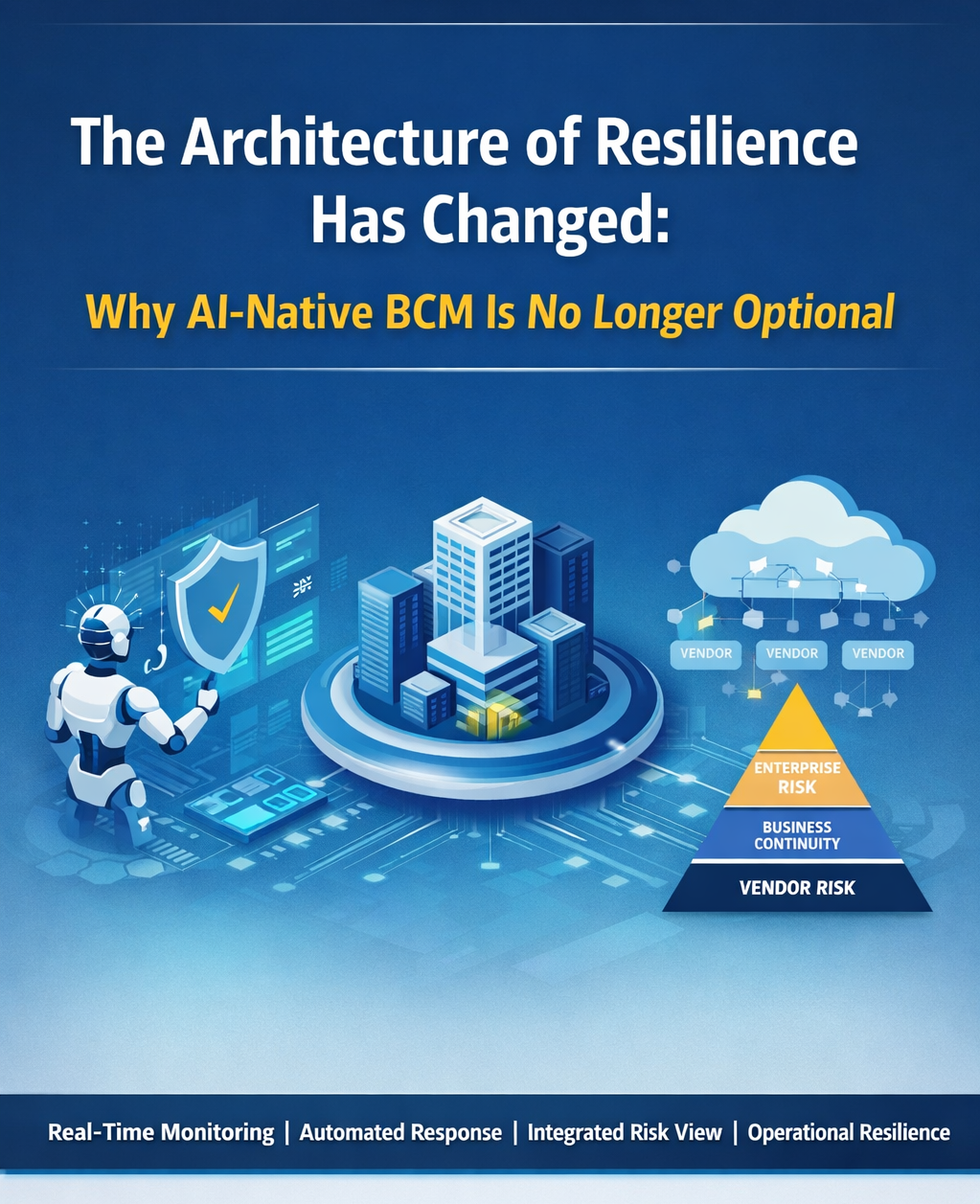
The Architecture of Resilience Has Changed: Why AI-Native BCM Is No Longer Optional

Operational Resilience | AI-Native BCM
The Architecture of Resilience Has Changed: Why AI-Native BCM Is No Longer Optional
Real-time monitoring • Automated response • Integrated risk view • Operational resilience
Most of us have spent years building business continuity management programs on platforms that were genuinely impressive for their time. We have customized them extensively, trained our teams on their quirks, and defended their annual licensing costs to CFOs who questioned the return. Those platforms served a purpose. In many organizations, they still sit at the center of BCM operations today.
But the risk landscape has not stood still while those platforms aged in place. The threat velocity, the interdependency of third-party ecosystems, the regulatory expectations, the sheer complexity of modern operations — none of it resembles what existed when most legacy BCM software was architected. And bolting AI modules onto platforms built for a different era is not the same as building for this one.
What I want to walk through here is not a vendor pitch. It is a practitioner's honest assessment of where the generational gap between legacy BCM tools and purpose-built AI-native platforms is becoming operationally significant — and why that gap matters most when we consider how BCM must connect to enterprise risk management and vendor management to give leadership a genuinely holistic view of risk.
The Legacy Platform Reality
Let us start by acknowledging what our legacy systems actually are. A 2025 survey of more than 500 U.S.-based IT professionals found that 62% of organizations still rely on legacy software systems, and that 43% cite security vulnerabilities as a major concern, while half report that the primary reason they have not upgraded is cost and institutional inertia.
That data reflects IT broadly, but BCM-specific platforms are not exempt. Many of the incumbent platforms in our space were built as structured document repositories with workflow overlays — places to store business impact analyses, recovery plans, contact lists, and exercise records. They were designed to help us organize information, not to act on it. The distinction matters enormously now.
Legacy systems tend to share several structural constraints that are well-documented across the industry. They suffer from monolithic architectures where all components are tightly interwoven, making meaningful updates difficult without risking instability elsewhere. They were not designed for the kind of seamless, real-time interoperability that characterizes today's risk environment, and outdated proprietary protocols make modern API-based integration complex and costly.
The most consequential limitation, however, is data. Legacy systems trap data in silos, prevent modern integrations, and limit performance in precisely the ways that matter most to risk leaders who need comprehensive, current information to make decisions. When legacy BCM vendors attempt to add AI capabilities to existing architectures, they frequently encounter a specific technical problem: the data is not clean, connected, or accessible enough for AI models to operate effectively. AI only delivers value when aligned with organizational goals and integrated into the operational backbone — and that requires a baseline architecture that most legacy platforms cannot provide without fundamental redesign.
The result is what practitioners in adjacent technology spaces have labeled "AI washing" — the rebranding of existing automation or workflow features as AI capabilities without substantive underlying change. Gartner has flagged this pattern directly in the agentic AI space, estimating that only a small fraction of vendors claiming agentic capabilities actually deliver them. The ask should always be the same: show us a live demonstration in real-world workflows, not a slide deck.
What AI-Assisted and AI-Agentic Actually Mean for BCM
Before discussing benefits, we need to be precise about terminology, because this market has already developed a serious language problem.
AI-assisted BCM means the system supports human decision-making. It surfaces patterns, generates analysis, flags anomalies, and presents options. A human reviews and decides. This is valuable, and it is achievable on better-architected legacy platforms when data quality is sufficient.
AI-agentic BCM goes further. Agentic AI represents a leap forward — these systems do not just follow instructions but set their own sub-goals, learn from context, and coordinate complex workflows in real time. Gartner describes agentic AI as an emerging category in which AI systems take action-based roles that operate independently or in collaboration with humans, and predicts that by 2028, 33% of enterprise software applications will include agentic AI, up from less than 1% in 2024.
For BCM, this distinction is consequential. An AI-assisted system might alert a BCM coordinator that a supplier is experiencing operational disruption. An AI-agentic system might simultaneously cross-reference that disruption against the organization's business impact analysis, identify which critical business processes are at risk, draft initial communications for crisis management teams, identify alternative suppliers from the vendor registry, and flag the event to the ERM register — all before a human has had time to process the first alert.
That is not a fantasy. It reflects the trajectory of a technology that Gartner projects will enable at least 15% of day-to-day work decisions to be made autonomously by 2028, up from effectively zero in 2024.
The Benefits of Purpose-Built AI-Native BCM
Predictive Risk Identification Rather Than Reactive Documentation
Traditional BCM platforms are primarily repositories. They store what we have already decided. AI-native platforms shift the orientation from documentation to anticipation.
AI helps identify geographic risk areas and guides BCM teams to contingency plans that reduce known risks, while also surfacing emerging geographical, environmental, and operational threats that had not been previously considered. AI-driven tools including predictive risk modeling, automated anomaly detection, and advanced natural language processing dramatically improve continuity outcomes, especially in cloud-native and distributed environments. Predictive risk modeling leverages AI to analyze historical data, environmental signals, and internal operational logs to anticipate disruptions before they materialize — fundamentally reorienting the BCM function from reactive to proactive.
This is the shift that matters strategically. AI now provides a toolkit of potential solutions that can transform continuity planning from a reactive checklist-driven approach into a more dynamic, predictive, and adaptive model.
Continuous and Dynamic Plan Maintenance
One of the most persistent weaknesses in legacy BCM programs is plan staleness. Recovery plans are written, exercised, updated annually if we are disciplined, and then sit relatively static until the next review cycle. The organization changes continuously; the plan does not keep pace.
AI-native systems can monitor internal data streams — system dependencies, personnel changes, process modifications, supplier updates — and surface plan inconsistencies in near-real time. AI agents can generate and run complex, realistic disaster scenarios that evolve dynamically, conduct automated analysis to identify vulnerabilities and improvement opportunities, and refine testing approaches based on each iteration and new data inputs. This is qualitatively different from scheduling an annual plan review. It means that when an organization restructures a business unit, the BCM platform identifies affected recovery plans, flags dependencies that have changed, and recommends updates — without waiting for the next exercise cycle.
Faster, More Reliable Incident Response
Speed in crisis matters. When a disruption occurs, the value of a BCM platform is measured in how quickly it enables coordinated response. Legacy systems require human navigation — finding the right plan, identifying the right contacts, working through manual checklists. AI-native systems can function as active participants in incident management.
The parallel with cybersecurity data is instructive. IBM's 2024 Cost of a Data Breach Report found that organizations employing AI and automation extensively detected and contained incidents an average of 98 days faster than those not using these technologies, and AI applied to prevention workflows reduced average breach costs by $2.2 million compared to organizations without AI in those workflows. The operational disruption dynamic applies equally to BCM events. When agentic AI can simultaneously assess impact, activate response workflows, coordinate communications, and track recovery progress — tasks that previously required multiple human coordinators working in sequence — the speed and comprehensiveness of response improves materially.
Scenario Intelligence at Scale
Effective BCM requires testing against a range of scenarios, not just the scenarios we find most comfortable. Legacy platforms support scenario documentation and tabletop exercises, but the scenarios themselves are largely human-generated, which means they reflect human cognitive limitations — recency bias, anchoring to past events, gaps in cross-functional imagination.
AI-native platforms can generate scenarios by ingesting threat intelligence, regulatory developments, supply chain signals, and internal operational data simultaneously. They can model cascading effects across business processes in ways that human-facilitated scenario planning rarely achieves. Predictive modeling by integrating external data sources allows AI to forecast potential future disruptions and test readiness for emerging threats in ways that static scenario libraries simply cannot replicate.
Addressing the Human Capital Challenge
Every CRO I speak with is navigating some version of the same problem: experienced BCM practitioners are not easy to hire, the workload on existing teams continues to expand, and manual processes consume capacity that should be spent on strategic program development. AI-native systems help address this directly by automating the high-volume, lower-judgment tasks — plan maintenance monitoring, exercise scheduling, status reporting, data quality checks — and freeing practitioners for the work that genuinely requires human expertise and judgment.
The Integration Imperative: BCM, ERM, and Vendor Management
BCM and ERM: The Case for Genuine Integration
PwC has articulated this clearly: organizations that integrate enterprise risk management into their strategic planning have found that business continuity management enhances both value creation and protection objectives. The confidence that comes from identifying and appropriately addressing interruption risks enables more bold execution of strategic plans — but gaining that confidence requires the genuine melding of ERM and BCM programs.
Too many organizations have these programs running on separate platforms, with separate data, reviewed by separate teams, and reported through separate governance tracks. The BCM team knows about recovery time objectives; the ERM team knows about risk appetite and impact thresholds. These two bodies of knowledge should be continuously informing each other. They often are not.
Regulators have made it clear that this is not optional. The FFIEC explicitly expects business continuity management to be integrated with enterprise risk management, with the depth and structure of that integration reflecting the institution's size, complexity, and risk profile. From an examination standpoint, the focus is less on how the framework is labeled and more on whether the organization is effectively identifying potential disruptions, assessing their likelihood and impact, and aligning its risk strategies to support overall operational resilience.
An integrated approach to BCM and ERM allows organizations to take a holistic view of their operations — spotting risks more accurately, gauging consequences on operations more realistically, and devising more coordinated management plans. Together, the two disciplines can actually strengthen one another rather than operating as parallel, overlapping bureaucracies. What AI-native BCM platforms make possible that legacy systems have not is genuine, continuous data integration. When the BCM system and the ERM system share a common data architecture — or are designed with open APIs that enable real-time data exchange — the business impact analysis informs risk appetite decisions, and risk tolerance decisions inform recovery strategy selection. The risk register and the recovery plan library are no longer documents maintained in parallel; they are connected artifacts that update in response to shared signals.
A practical example: when ERM identifies an elevated operational risk in a specific geography due to geopolitical developments, the AI-native BCM platform can automatically scan recovery plans that rely on resources or dependencies in that geography, flag plans that may be insufficient, and propose recovery strategy adjustments — before a disruption occurs. This is the feedback loop that practitioners have long recognized as theoretically valuable and practically difficult to achieve with disconnected systems.
Vendor Management: The Blind Spot That Has Become a Board-Level Issue
The data on third-party risk has become impossible to ignore. Verizon's 2025 Data Breach Investigations Report — analyzing over 22,000 security incidents — found that third-party involvement in breaches doubled year-over-year, from 15% to 30%. That is not a statistical artifact. It reflects the structural reality that our organizations' resilience is now functionally inseparable from our vendors' resilience.
The ERM trend data reinforces this. Third-party involvement in breaches at 30% makes vendor risk perhaps the most critical enterprise vulnerability. Traditional third-party risk management relied on point-in-time assessments — annual questionnaires, periodic audits, and static risk ratings.
Despite this, only 13% of organizations have achieved optimized AI and automation in their third-party risk management programs according to EY's 2025 Global Third-Party Risk Management Survey. That gap between the scale of the problem and the maturity of the tooling is significant.
BCM programs have historically treated vendor risk as a parallel concern — something handled by procurement or a separate vendor risk management team, with BCM receiving periodic updates about critical supplier status. That model is inadequate when a single supplier disruption can cascade across dozens of critical business processes simultaneously, or when regulatory expectations now require demonstrable integration between these disciplines.
The Deloitte Luxembourg analysis of evolving third-party risk regulatory expectations makes this concrete: the Financial Stability Board, Basel Committee, and ESMA have all issued guidance emphasizing robust third-party risk management frameworks, and the EBA's most recent consultation paper proposes broadening requirements beyond just outsourcing and ICT arrangements. The regulatory expectation of integrated, demonstrable third-party resilience management is becoming standard across sectors, not just financial services.
What Genuine Three-Way Integration Looks Like
When BCM, ERM, and VM operate on a connected, AI-enabled architecture, the capabilities that become available to risk leaders are qualitatively different from what disconnected systems can provide:
The BCM business impact analysis directly informs vendor criticality assessments. When a business process is identified as time-critical, the system can automatically identify which vendors support that process and elevate their risk monitoring priority.
When a vendor shows signs of financial distress, operational instability, or geographic concentration risk — signals that modern vendor risk platforms can monitor continuously — the BCM system can proactively assess which recovery plans depend on that vendor and flag them for review or pre-emptive mitigation.
When ERM identifies an elevated enterprise risk, the system can cross-reference which critical business functions are exposed to that risk, which vendors support those functions, and which recovery plans address those scenarios — providing leadership with a complete, current picture rather than a patchwork of manually assembled information.
The ERM trend toward integrated platforms is already producing measurable results. Integrated platforms achieve 25-50% reduction in implementation time and up to 70% reduction in maintenance overhead by eliminating custom integration development. These are not trivial operational gains for risk functions that are typically resource-constrained.
A Word on Governance and the Human Role
I want to address something directly, because it comes up in every conversation about AI-native risk technology.
The appropriate concern about AI autonomy in risk management is not whether the technology can act, but whether governance structures are sufficient to ensure it acts appropriately. Gartner's data that over 40% of agentic AI projects will be cancelled by end of 2027 due to escalating costs, unclear business value, or inadequate risk controls is a genuine caution. Deploying agentic capabilities without clear governance, transparency, and human oversight structures is a risk management failure, not an innovation.
The appropriate model for BCM is not replacing human judgment with AI judgment. It is creating governance structures that define precisely which tasks AI agents handle autonomously, which decisions require human review before action, and what audit trail is maintained throughout. The BCM program manager's role evolves from plan maintainer to AI governance steward — ensuring that the intelligence of the system remains aligned with organizational risk appetite and that its outputs are trustworthy enough to inform executive decision-making under pressure.
AI-agentic BCM platforms should be evaluated rigorously on this dimension. Look for genuine transparency about how the AI reaches conclusions, clear audit trails, configurable autonomy boundaries, and demonstrated ability to explain its reasoning in terms that risk professionals and auditors can evaluate.
Practical Considerations for the Path Forward
For colleagues who are evaluating how to move forward, a few observations that I believe are grounded in operational reality:
The case for replacement rather than augmentation is stronger than vendors of legacy systems will acknowledge. Integrating new AI modules onto architectures that were not designed for modern data connectivity tends to produce expensive, brittle solutions that require significant ongoing maintenance investment. The observation that integrating agents into legacy systems can be technically complex — often disrupting workflows and requiring costly modifications — and that rethinking workflows with agentic AI from the ground up is frequently the better path applies directly to the BCM technology decision.
Start the integration conversation before the technology conversation. The most common failure mode in BCM platform modernization is selecting technology before the organization has clarity on how BCM, ERM, and VM governance will actually connect. Platform capabilities can only operationalize integration that organizational structure and governance have already enabled in principle.
Demand live demonstrations in real-world scenarios. The distinction between genuine agentic capability and rebranded automation is often only visible in practice. A platform that genuinely adapts, reasons about novel scenarios, and demonstrates goal-setting behavior will show this in a live demonstration. One that is repackaging scripted automation will struggle.
The GRC market trajectory validates investment urgency. The global GRC software market reached $38 billion in 2024 and is projected to reach $138 billion by 2030, a 15.4% CAGR that significantly outpaces general enterprise software growth. Early adopters of genuinely integrated, AI-native platforms will have operational and competitive advantages that widen as these capabilities mature.
Closing Perspective
The BCM function exists to ensure that our organizations can continue to operate, serve customers, meet obligations, and protect people when things go wrong. That mission has not changed. What has changed — substantially — is the environment in which we pursue it.
The threats are faster, more interconnected, and more often originating through our vendor ecosystem rather than directly against our own operations. The regulatory expectations for demonstrable, integrated resilience management are higher. The volume of relevant data that should inform BCM decisions is greater than any human team can practically process.
AI-native BCM platforms, properly governed and genuinely integrated with ERM and VM, are not a solution in search of a problem. They are a proportionate response to an environment that legacy platforms were not built to address.
The question for each of us is not whether this shift will happen — the technology trajectory and the risk environment make that increasingly certain. The question is whether we lead this transition strategically, or manage it reactively when the gap between our platform capabilities and our operational requirements becomes visible to leadership at the worst possible moment.
We have an opportunity to shape the architecture of resilience in our organizations. I believe we should take it.
Sources
- BDA Global. The Business Continuity / Artificial Intelligence Revolution.
https://www.bdaglobal.com/2025/10/21/the-business-continuity-artificial-intelligence-revolution/ - Bay Tech Consulting. Legacy Software Modernization: A Guide to Unlocking Scalability.
https://www.baytechconsulting.com/blog/legacy-software-modernization-a-guide-to-unlocking-scalability - Bryghtpath. BCM versus ERM: A Guide for Strategic Risk Management.
https://bryghtpath.com/business-continuity-versus-enterprise-risk-management/ - ConnectWise. Agentic AI vs. AI agents: Choosing the right approach for recovery and resilience.
https://www.connectwise.com/blog/agentic-ai-vs-ai-agents - Continuity Insights. Enhancing Business Continuity Planning With Artificial Intelligence.
https://continuityinsights.com/enhancing-business-continuity-planning-with-artificial-intelligence/ - Deloitte Luxembourg. Preparing for third-party risk management.
https://www.deloitte.com/lu/en/our-thinking/future-of-advice/preparing-third-party-risk-management.html - Diligent. Enterprise risk management (ERM) trends for 2026.
https://www.diligent.com/resources/blog/erm-trends-2024 - Edstellar. 10 Core AI Applications in Business Continuity.
https://www.edstellar.com/blog/ai-applications-in-business-continuity - Gartner. How Intelligent Agents in AI Can Work Alone.
https://www.gartner.com/en/articles/intelligent-agent-in-ai - Gartner. Gartner Predicts Over 40% of Agentic AI Projects Will Be Canceled by End of 2027.
https://www.gartner.com/en/newsroom/press-releases/2025-06-25-gartner-predicts-over-40-percent-of-agentic-ai-projects-will-be-canceled-by-end-of-2027 - IBM Newsroom. IBM Report: Escalating Data Breach Disruption Pushes Costs to New Highs.
https://newsroom.ibm.com/2024-07-30-ibm-report-escalating-data-breach-disruption-pushes-costs-to-new-highs - PwC. Enterprise risk management and business continuity management: Together at last.
https://www.pwc.com/us/en/services/consulting/cybersecurity-risk-regulatory/library/ERM-business-continuity.html - Relevance AI. Business Continuity Plan Testing AI Agents.
https://relevanceai.com/agent-templates-tasks/business-continuity-plan-testing-ai-agents - Saritasa. Legacy Software Modernization in 2025: Survey of 500+ U.S. IT Pros.
https://www.saritasa.com/insights/legacy-software-modernization-in-2025-survey-of-500-u-s-it-pros - Verizon. 2025 Data Breach Investigations Report.
https://www.verizon.com/about/news/2025-data-breach-investigations-report
ERM Pilot is built for risk and compliance teams at financial institutions who are ready to stop working for their software and start letting their software work for them. See what's possible →