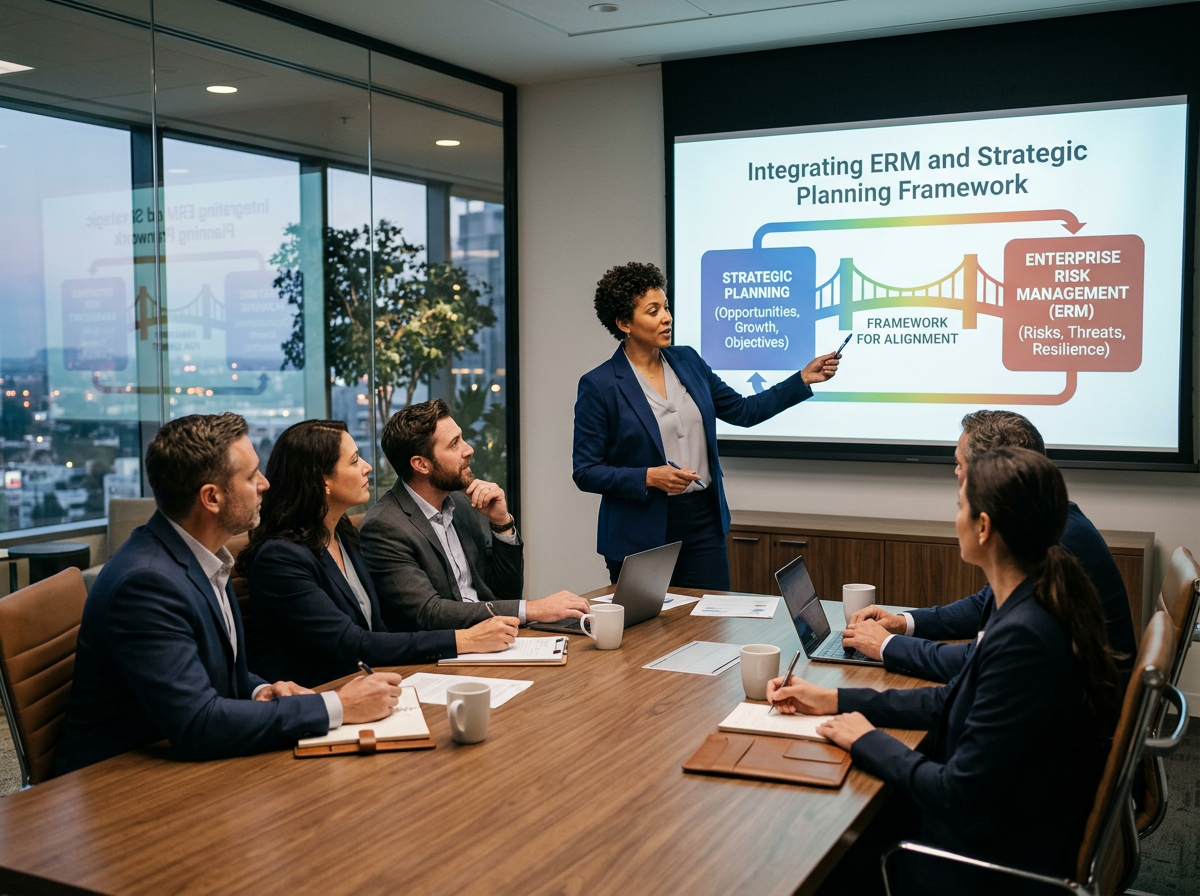
Connecting ERM to Strategic Planning: A Framework for Executives

Strategy Alignment | Enterprise Risk Management
Connecting ERM to Strategic Planning: A Framework for Executives
Turning risk from a reporting function into a strategic decision-making capability
Most organizations say risk is part of strategy.
In practice, Enterprise Risk Management (ERM) often operates beside strategic planning—not inside it.
Strategy is developed.
Budgets are set.
Growth initiatives are approved.
ERM is then asked to assess the risks.
For executives, the real question is no longer whether ERM supports strategy. It is:
"Does our ERM program actively shape the decisions that define our future?"
Below is a practical executive-level framework for connecting ERM to strategic planning—using the same disciplines leaders already expect from both functions.
ERM Must Be Positioned As A Strategic Input, Not A Post-Decision Review
The most common disconnect occurs at the very start of the planning cycle.
ERM is typically engaged:
- after strategic options are selected
- after financial targets are set
- after major initiatives are already defined
When that happens, ERM can only validate risk—not influence direction.
What effective alignment looks like:
- risk leaders participate in early strategy formulation discussions
- risk themes are introduced alongside market and financial analysis
- leadership receives risk-adjusted perspectives on strategic options
Executives should expect ERM to contribute to questions such as:
- Which growth paths introduce the most uncertainty?
- Which strategic bets amplify existing risk concentrations?
- Where does our operating model become fragile under scale?
Strategic Risks Must Be Explicitly Linked To Strategy
Many organizations maintain a list of "top risks" that exist independently of their strategic goals and projects. That separation weakens both.
Executives should be able to clearly see:
- which risks threaten specific strategic objectives
- which assumptions underpin each strategic initiative
- which execution risks could derail delivery
What strong linkage looks like:
- strategic objectives and initiatives mapped directly to enabling and constraining risks
- key assumptions documented as risk conditions
- ownership of strategic risks assigned to accountable executives
ERM should be able to answer:
- Which risks matter most to this strategy—not just to the enterprise overall?
Risk Appetite Must Be Translated Into Real Strategic Trade-Offs
Risk appetite statements often remain abstract. They describe tolerance in principle—but not in decision context.
To connect ERM to strategy, executives need to see how appetite applies to real choices.
That means:
- translating appetite into thresholds relevant to growth, capital, technology, and operating scale
- clarifying where leadership is willing to accept uncertainty—and where it is not
- showing how competing initiatives consume limited risk capacity
Executives should expect ERM to support discussions such as:
- which initiatives push the organization beyond acceptable operational or execution risk
- which investments materially increase dependency on fragile processes or partners
- which strategic paths concentrate exposure in ways the organization has not previously managed
Strategic Scenarios Must Be Treated As Risk Scenarios, Not Planning Narratives
Scenario planning is often performed as a business exercise. ERM scenario analysis is often performed as a risk exercise.
When these remain separate, leadership loses a powerful decision tool.
A connected approach includes:
- using strategic scenarios as formal risk scenarios
- testing how controls, operating capacity, and governance perform under strategic stress
- identifying failure modes within growth and transformation programs
Executives should expect insight into:
- how execution risk changes under aggressive growth
- how regulatory, technology, or talent constraints alter strategic feasibility
- how adverse combinations of events amplify strategic impact
The objective is not to limit ambition. It is to reveal fragility before the organization commits.
Execution Risk Must Be Monitored As Closely As Strategic Performance
Once strategy is approved, performance indicators dominate executive reporting. Risk indicators often fade into periodic reviews.
That separation creates blind spots.
To connect ERM to strategy, institutions must monitor:
- early execution risk signals
- operational and technology stress indicators
- third-party and capacity constraints tied to strategic programs
Executives should be able to see:
- leading risk indicators aligned to strategic initiatives
- changes in risk conditions during delivery—not after delays or failures occur
- escalation of material execution risks while mitigation options still exist
ERM must move from reporting enterprise risk trends to actively supporting strategic delivery governance.
Strategic Decisions Must Be Informed By Connected, Cross-Domain Risk Insight
Strategic initiatives rarely create risk in only one domain.
They typically introduce:
- operational risk
- technology and cyber risk
- third-party risk
- compliance and regulatory exposure
- financial and capital impacts
Executives should expect ERM to integrate these perspectives into a single view.
What strong programs demonstrate:
- cross-domain risk relationships for each major initiative
- shared risk language and classification across functions
- consistent assessment of severity and impact
This enables leadership to see:
- how a single strategic decision can create multiple, reinforcing exposures
- where mitigation in one domain shifts risk into another
- where responsibility for risk becomes fragmented
Strategic Planning Must Include Explicit Risk Ownership And Governance
Many strategic initiatives fail not because risks were unknown—but because ownership was unclear.
Connecting ERM to strategy requires:
- assigning accountable executives for strategic risks
- embedding risk oversight into program governance
- linking escalation pathways directly to executive committees
Executives should expect clarity on:
- who owns the most material risks associated with each initiative
- how risk decisions are escalated when tolerance is approached
- how trade-offs are resolved when delivery pressure conflicts with risk limits
ERM becomes part of strategic governance—not a parallel reporting structure.
Risk Intelligence Must Be Forward-Looking, Not Retrospective
For ERM to meaningfully influence strategy, it must focus on what is forming—not only what has occurred.
Executives should expect ERM to provide:
- early warning indicators tied to strategic assumptions
- trend analysis across operations, technology, talent, and partners
- signals that execution conditions are deteriorating or improving
This enables leadership to:
- adjust strategy while options still exist
- reprioritize investments before momentum is lost
- intervene before delivery failure becomes visible externally
What Executives Should Require From An ERM–Strategy Connection
- direct linkage between strategy and enterprise risk
- risk-adjusted comparisons between strategic options
- early risk indicators for strategic execution
- clearly assigned ownership for strategic risks
- escalation mechanisms aligned to decision timelines
Bottom Line
Connecting ERM to strategic planning is not about adding another approval step. It is about embedding risk intelligence into the choices that shape the organization's future.
When ERM is fully connected to strategy, leaders gain:
- clearer visibility into execution risk
- stronger understanding of strategic fragility
- better-informed trade-offs between growth and resilience
The organizations that succeed will not ask:
"How do we assess the risks of our strategy?"
They will ask:
"How does risk intelligence actively shape the strategy we choose?"
ERM Pilot is built for risk and compliance teams at financial institutions who are ready to stop working for their software and start letting their software work for them. See what's possible →